Reduce Power
From straight-and-level flight, gradually reduce power from the normal cruise setting. Allow the airplane to begin slowing down while maintaining the desired heading and altitude.

In this lesson, you will learn how to recognize, enter, maintain and recover from slow flight. You will also learn the HASEL check, how the airplane behaves at low airspeed, and how to maintain precise control during turns, climbs and descents. This lesson builds on the control of attitude and altitude covered in Straight-and-Level Flight .
Slow flight develops precise control when the airplane is operating close to the lower end of its normal airspeed range. It also helps you recognize the signs that appear as the airplane approaches a stall.
The flight controls become less responsive as airspeed decreases. Slow-flight practice teaches you to make smooth and precise corrections.
Slow flight helps you recognize changes in aircraft attitude, control response and stall warning before an actual stall develops.
The airplane operates at relatively low airspeeds during takeoff, approach, landing and go-around. Good slow-flight skills therefore apply directly to normal flying.
Slow flight requires careful coordination, especially when power is high and airspeed is low. It develops better use of pitch, power and rudder.
Slow flight is flight in the low-speed range between the airplane's maximum-endurance speed and a speed just above the stall. In this range, the airplane remains under control, but it behaves very differently from normal cruise flight.
During slow flight, the airplane operates close to the lower limit of its usable airspeed range. The wing is still producing enough lift to maintain flight, but the airplane is closer to the conditions that can produce a stall.
The objective is therefore not simply to fly as slowly as possible. It is to learn how to control the airplane precisely at low airspeed while preventing a stall.
The airplane is flown at a low airspeed, often close to the minimum speed at which controlled flight can be maintained without stalling.
As airspeed decreases, the airplane normally requires a higher angle of attack to produce the lift needed for flight.
With less airflow over the control surfaces, the controls generally feel softer and corrections may require larger or more deliberate inputs.
Slow flight is not a stall. The wing remains below its critical angle of attack. However, because the airplane is operating close to the stall, an increase in angle of attack, load factor or an inappropriate reduction in power can bring the airplane closer to a stall.

As an airplane slows down, less air flows over the wing. To continue producing enough lift, the airplane must normally fly at a higher angle of attack. This changes the relationship between pitch, drag, power and control response.
In level flight, the wing must continue producing enough lift to support the airplane. When airspeed decreases, the pilot normally increases the angle of attack to maintain the required lift.
The slower the airplane flies, the closer the wing moves toward its critical angle of attack. If that critical angle is exceeded, the wing stalls.
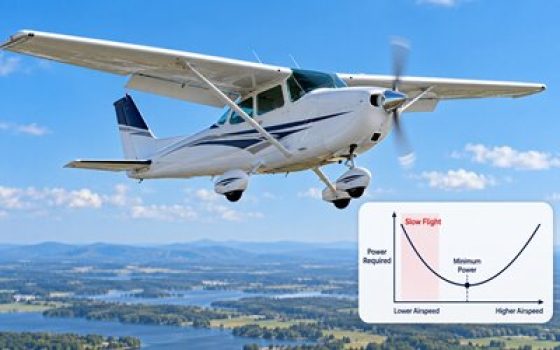
Move the slider from higher airspeed toward the stall to see why more power is required to maintain altitude in slow flight.
Move the slider toward the left. At first, reducing airspeed reduces the power required. After maximum endurance, the relationship reverses.
On the slow-flight side of the curve, flying slower requires more power to maintain altitude because induced drag increases rapidly.
The wing must normally operate at a higher angle of attack to produce the lift required at lower airspeed.
At high angle of attack, induced drag becomes much more important. This is why more power is required to maintain altitude in slow flight.
Lower airflow over the control surfaces reduces their effectiveness. Larger or more deliberate control inputs may therefore be required.
At normal cruise speeds, slowing down generally reduces the power required. But at sufficiently low airspeed, induced drag becomes so large that this relationship reverses.
In this region, flying even slower requires more power to maintain altitude. This is often called the back side of the power curve or the region of reversed command.
During slow flight, small pitch changes can produce noticeable changes in airspeed and angle of attack, while power changes are commonly used to help maintain the desired flight path and altitude. Use the technique recommended for your airplane and by your instructor.
Before entering slow flight, make sure the airplane is at a safe altitude, in a suitable practice area, properly secured, and clear of other traffic. The HASEL check is a simple way to organize these important pre-maneuver checks.
Make sure there is enough altitude to perform the exercise safely and recover if an inadvertent stall occurs.
Choose a suitable practice area and consider terrain, obstacles, populated areas, airspace and possible emergency landing areas.
Check seat belts, doors and windows, and make sure loose objects are secured before beginning the maneuver.
Check engine indications and complete the appropriate aircraft checks according to the checklist and POH/AFM.
Clear the area carefully for other traffic before beginning the maneuver and maintain an effective visual scan throughout the exercise.
The exact engine check depends on the airplane, but a typical check before slow-flight practice may include:
Always use the checklist and POH/AFM for the specific airplane. Not every airplane has the same fuel selector, carburetor system, mixture procedure or engine controls.
During slow flight, the airplane operates at low airspeed and a relatively high angle of attack. This means the airplane is closer to the conditions that can produce a stall.
Starting the maneuver with enough altitude, a clear practice area and a proper lookout gives the pilot the time and space needed to respond safely if something does not go as planned.
Do not memorize one generic engine or cockpit checklist for every airplane. Fuel selection, mixture, carburetor heat, propeller controls and other items vary between aircraft. Follow the POH/AFM, aircraft checklist and your instructor's procedure.
Once the pre-maneuver checks are complete, enter slow flight gradually. The objective is to reduce airspeed while maintaining altitude and coordinated flight, then stabilize the airplane at the desired slow-flight speed.
From straight-and-level flight, gradually reduce power from the normal cruise setting. Allow the airplane to begin slowing down while maintaining the desired heading and altitude.
As airspeed decreases, gradually increase the pitch attitude as necessary to prevent the airplane from descending. The angle of attack increases as the airplane slows.
If the exercise is being performed in a landing, takeoff or other configuration, extend flaps or landing gear as appropriate and only within the applicable operating limitations.
As the airplane approaches the desired slow-flight speed, increase power as necessary to maintain altitude. At this low airspeed, induced drag is high, so considerable power may be needed even though the airplane is flying slowly.
Use rudder as required to keep the airplane coordinated as power and angle of attack increase. Once the desired airspeed, altitude and attitude are established, trim the airplane to reduce unnecessary control pressure.
The exact target speed depends on the airplane, configuration and training objective. In typical slow-flight training, the airplane is stabilized at a speed just above the stall warning or stall condition for the selected configuration.
Use the POH/AFM and your instructor's procedure rather than memorizing one airspeed for every airplane.
In a Cessna 172, the exact power setting, flap configuration and target airspeed can vary between models and training procedures. Do not treat a single RPM or airspeed value as universal. Use the POH for the specific aircraft and follow your instructor's technique.

Once the airplane is established in slow flight, do not rely on the airspeed indicator alone. Learn to recognize the airplane's attitude, control feel, sound and coordination, while using outside references and the flight instruments to maintain precise control.
Slow flight feels noticeably different from normal cruise. The airplane is operating at low airspeed and a relatively high angle of attack, so the controls are less responsive and the airplane requires more deliberate control inputs.
With practice, these changes become important visual, physical and audible cues that help you recognize when the airplane is approaching the slow-flight range.
The airspeed is much lower than in normal cruise. Use the indicator as part of your scan, but avoid staring continuously at it.
The airplane normally flies with a noticeably higher angle of attack than during normal cruise flight.
Lower airflow over the control surfaces makes the controls feel less effective. Corrections may require larger or more deliberate inputs.
As airspeed decreases, the sound of the airflow around the airplane changes. This is another useful cue that the airplane is slowing down.
Even though the airplane is moving slowly, substantial power may be required to overcome induced drag and maintain altitude.
In a propeller-driven airplane, high power at low airspeed can increase yawing tendencies. Use rudder as required to remain coordinated.
Once the desired slow-flight condition is established, make small, smooth corrections. In stabilized slow flight, small pitch changes have a strong effect on airspeed, while power changes have a strong effect on altitude and flight path.
These controls are not completely independent. Changing pitch also affects altitude, and changing power can affect airspeed and pitch attitude. Think of pitch and power as a coordinated pair, not as two completely separate controls.
Correct the pitch smoothly, then allow the airplane time to respond before making another adjustment. Avoid chasing the airspeed indicator.
Use an appropriate power correction to regain or maintain the desired altitude, while coordinating pitch as necessary.
Apply the rudder needed to keep the airplane coordinated. Avoid using excessive aileron or making abrupt control inputs at low airspeed.
Slow flight is a visual maneuver. Maintain awareness of the horizon and outside references, then make brief instrument checks for airspeed, altitude, heading and coordination. Do not allow the instrument panel to become your only reference.
Slow flight places the airplane closer to the stall, but slow flight is not a stall. Maintain precise control and avoid abrupt pitch or control inputs that could increase the angle of attack beyond its critical value.
Depending on the airplane and the training target, you may be operating close to the activation point of the stall-warning system. Do not use the warning device as the primary method of controlling slow flight.
Once the airplane is stabilized, use trim to relieve continuous control pressure. Trim helps you make precise corrections, but it does not replace active control of pitch, power and coordination.
To exit slow flight, smoothly transition the airplane back toward normal flight while maintaining altitude and coordinated control. As power is increased and the airplane accelerates, control the pitch attitude to reduce the angle of attack, then return the airplane progressively to its normal configuration.
Smoothly increase power to begin accelerating out of slow flight. As airspeed and lift increase, apply the forward elevator pressure needed to reduce the angle of attack and maintain altitude.
The airplane may be trimmed for a high-angle-of-attack, low-speed condition. When power is added and airspeed increases, the airplane may develop a noticeable nose-up tendency. Maintain the required forward control pressure and do not allow the nose to rise excessively.
Continue adjusting pitch as the airplane accelerates so that altitude remains controlled. Use rudder as required to maintain coordinated flight, particularly as power changes in a single-engine propeller airplane.
If flaps or landing gear were extended, return the airplane progressively toward its normal configuration as airspeed increases. Follow the POH/AFM and aircraft procedures for the correct sequence and operating limitations.
Continue holding the required control pressure while the airplane accelerates. Once the desired airspeed, pitch attitude and power setting are established, retrim for the new flight condition and stabilize the airplane.
During slow flight, the airplane may be trimmed to relieve the back pressure needed for the higher angle of attack. That trim setting does not automatically become appropriate when power is added and the airplane accelerates.
Maintain the required forward elevator pressure while the flight condition changes, then retrim progressively once the desired attitude and airspeed are established.
Flap retraction changes both lift and drag. Retracting flaps while the airplane is still at very low airspeed can require an immediate change in pitch control to maintain the desired angle of attack and flight path.
Allow the airplane to accelerate and retract the configuration progressively according to the procedure for the aircraft you are flying.
In a single-engine propeller airplane, increasing power can produce both pitch and yaw changes. Anticipate these tendencies and use coordinated elevator and rudder inputs while the airplane accelerates.
Increasing airspeed does not by itself protect the airplane from a stall. An airplane stalls when the critical angle of attack is exceeded, regardless of the indicated airspeed.
During the transition out of slow flight, control the nose attitude as power and airspeed increase. If an actual stall occurs, use the appropriate stall-recovery procedure for the airplane.
Slow flight can be practiced with different flap settings. Changing the flap configuration changes the airplane's lift, drag, pitch attitude, stall speed and trim, so each configuration requires slightly different control inputs.
With the flaps retracted, drag is lower and the airplane generally has a higher stall speed than it does with flaps extended.
Lift and drag increase, and the airplane may require a different pitch attitude, power setting and trim to maintain slow flight.
Drag is substantially higher and the airplane can typically operate at a lower airspeed before reaching the stall than in the clean configuration.
Extending flaps changes the shape and camber of the wing. On most training airplanes, this increases both lift and drag and reduces the stall speed for that configuration.
The airplane may also experience a noticeable pitch change when the flaps move. The direction and amount of that pitch change depend on the aircraft design and flap system.
Because drag increases, more power may be required to maintain altitude at the same low airspeed. Once the new configuration is stabilized, retrim the airplane as required.
When flaps are extended during slow flight, both lift and drag change. The airplane may change pitch attitude and begin to accelerate or decelerate unless the pilot adjusts pitch and power.
Make configuration changes progressively, anticipate the aerodynamic response, and stabilize the airplane before making another major change.
Retracting flaps removes some of the additional lift they were providing. If the airplane is still flying very slowly, abrupt flap retraction can produce a significant loss of lift and reduce the margin from the stall.
Always respect the aircraft's flap operating limitations. Extend or retract the flaps only within the permitted airspeed range and use the flap settings and sequence specified in the POH/AFM.
Slow flight with the flaps retracted does not feel exactly like slow flight with partial or full flaps. Practicing different configurations helps you recognize how control response, pitch attitude, stall speed and power requirements change.
These differences are directly relevant to normal flying because the airplane routinely operates at low airspeeds and changing flap settings during takeoff, approach, landing and go-around.
Once straight-and-level slow flight is stable, the next step is to maneuver while keeping the airplane coordinated and safely above the stall. Turns, climbs and descents require different combinations of pitch, power and rudder, but all control inputs should remain smooth and deliberate.
Enter the turn with smooth, coordinated aileron and rudder inputs. Because part of the total lift is now directed horizontally to produce the turn, more total lift is required if altitude is to remain constant.
In slow flight, avoid trying to hold altitude by simply pulling farther back on the elevator. Excessive back pressure increases the angle of attack and reduces the margin from the stall.
To begin a climb while remaining in slow flight, smoothly increase power and adjust pitch as necessary to maintain the desired slow-flight airspeed.
Do not attempt to increase the climb rate simply by raising the nose. Increasing pitch without sufficient power increases the angle of attack and can move the wing closer to its critical angle of attack.
In a single-engine propeller airplane, the higher power setting can also increase yawing tendencies, so anticipate the need for additional rudder.
To establish a descent from stabilized slow flight, smoothly reduce power and adjust pitch as required to maintain the desired airspeed.
The airplane should be allowed to descend rather than allowing the airspeed to decay. Continue monitoring coordination and angle of attack throughout the descent.
Remember that descending does not automatically move the airplane farther from a stall. A stall still occurs whenever the critical angle of attack is exceeded.
In a level turn, increasing bank increases load factor. The wing must produce more lift, which requires a higher angle of attack and increases stall speed. Avoid aggressive bank and abrupt elevator inputs during slow flight.
Maintain coordinated flight during turns, climbs and descents. At low airspeed, excessive yaw combined with a high angle of attack can create the conditions for a stall-and-spin entry.
Slow flight requires precise control because the airplane is operating at low airspeed and relatively close to the critical angle of attack. The safest technique is to remain coordinated, attentive and smooth, and to correct small deviations before they become large ones.
Maintain an effective traffic scan and awareness of the horizon. Instruments support the maneuver — they should not become your only reference.
Use rudder as required to prevent unwanted yaw, particularly when operating at high power and low airspeed.
Avoid abrupt pitch or control inputs. Slow flight can quickly become a stall if the critical angle of attack is exceeded.
Most slow-flight problems come from a small number of recurring habits: poor pitch control, inadequate coordination, fixation inside the cockpit, incorrect power management, or failing to anticipate a configuration change.
Instead of simply correcting the resulting altitude or airspeed deviation, identify what caused it and make a smooth, measured correction.
As power is reduced, the airplane begins to descend instead of maintaining altitude.
Increase pitch progressively as the airplane slows and use outside attitude references to maintain altitude.
The airplane climbs while airspeed decreases rapidly, moving closer to the stall.
Establish the attitude progressively and allow the airplane time to respond instead of making one large elevator input.
High power and low airspeed can produce significant yaw in a propeller-driven airplane.
Anticipate the yawing tendency and use rudder as required rather than waiting for the airplane to become uncoordinated.
Too little or too much power results in unwanted altitude, airspeed or flight-path changes.
Adjust power smoothly, coordinate the resulting pitch and rudder changes, and allow the airplane to stabilize.
Staring at the airspeed indicator or another instrument reduces traffic awareness and often leads to chasing small indications.
Use the horizon and airplane attitude as primary references, with short instrument checks to confirm performance.
Concentrating on one task can allow heading, altitude, coordination or traffic awareness to deteriorate.
Divide attention between outside references, aircraft control, instruments and traffic rather than completing each task in isolation.
Extending or retracting flaps changes lift, drag, pitch and angle of attack. An abrupt change can destabilize the airplane.
Make configuration changes progressively, control pitch and airspeed, then stabilize before continuing.
Flying with excessive control pressure makes precise slow-flight control more difficult and increases workload.
Use the flight controls to establish the desired condition, then trim to relieve continuous control pressure.
If a stall warning, aerodynamic buffet or another stall cue occurs during normal slow-flight practice, respond promptly by reducing the angle of attack and adjusting power as necessary while maintaining coordinated flight. Do not continue pulling back simply to maintain altitude.
Failure to adequately clear the area is one of the FAA's listed common slow-flight errors. Complete the appropriate lookout before entry and continue scanning for traffic throughout the maneuver.
Before moving on, check that you understand the key ideas behind slow flight. Try to answer each question before opening the answer.
These questions cover the main concepts from this lesson: aerodynamics, HASEL, entry and exit, flap configuration, maneuvering and stall awareness.
At low airspeed, the airplane needs a higher angle of attack to produce the required lift. This increases induced drag, so more power may be required to maintain altitude.
HASEL organizes the important checks before beginning the maneuver, including sufficient altitude, a suitable area, a secure cockpit, engine checks and traffic lookout.
As airspeed decreases, increase pitch as required to maintain altitude. Then add power as necessary as the airplane approaches the desired slow-flight condition.
The airplane may be trimmed for a high-angle-of-attack condition. As power, airspeed and lift increase, apply the required forward elevator pressure to reduce angle of attack and maintain altitude.
Flap extension also changes pitch and trim, and typically lowers the stall speed for the selected configuration.
Increasing bank in a level turn increases load factor and stall speed. Excessive back pressure also increases angle of attack, moving the wing closer to the stall.
Use rudder as required to keep the airplane coordinated. Excessive yaw combined with a high angle of attack can create conditions for a stall-and-spin entry.
A wing stalls when it exceeds its critical angle of attack. The indicated airspeed at which that occurs can change with load factor, configuration and other flight conditions.
You should be able to explain not only what control input to make, but also why the airplane responds that way. If one of these answers is unclear, revisit the corresponding section before continuing.
Want to go further? Continue with the related Pilot Institute training lesson for additional ground-school instruction.
View the Training Lesson → Paid training course. Affiliate link — StudyFlight may earn a commission at no additional cost to you.Tags: slow flight