Short Field Landing: Complete Pre-Flight Lesson

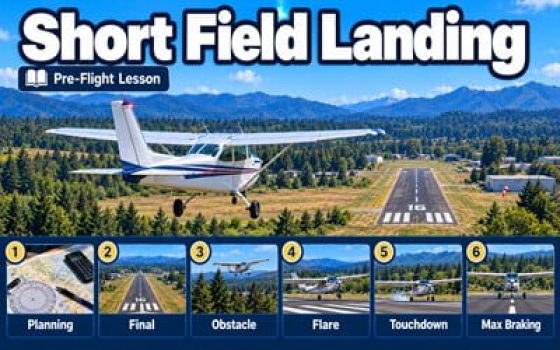
Cessna 172 approaching a short runway, illustrating six stages of a short field landing: planning, final approach, obstacle clearance, flare, touchdown, and maximum effective braking.
Pre-Flight Lesson Approach & Landings
Lesson Objective

A short field landing requires precise control of airspeed, descent path, touchdown position and deceleration when the available landing distance is limited. This pre-flight lesson explains how to plan and perform a short field approach and landing in a light training airplane.

You will learn the techniques used for short field landings without obstacles and short field landings over obstacles, including how the approach profile changes when terrain or obstructions must be cleared before reaching the runway.

The lesson covers landing distance planning, recommended approach airspeed, flap configuration, stabilized descent, precise touchdown and braking. It also explains common short field landing errors and when a go-around is the safer decision.

This lesson builds directly on the Normal Approach and Landing Pre-Flight Lesson , which introduces the normal landing sequence, aiming point, flare, touchdown and landing roll. Always follow the approved AFM/POH, aircraft performance data and applicable checklists for specific speeds, flap settings, landing distances and procedures.

Understand Landing Distance and Precision

Understand how limited runway length, obstacles, airspeed and runway conditions affect the safety of a short field landing.

Practice Short Field Landing Techniques

Learn the step-by-step approach and landing procedures, with and without obstacles, from final approach through the landing roll.

Decide Continue or Go Around

Recognize excessive airspeed, unstable approaches, inaccurate touchdown predictions and insufficient stopping margins.

Why Study Short Field Landings? On a short runway, every part of the landing matters.

During a normal landing, the pilot must already control approach speed, glidepath and touchdown attitude. A short field landing places greater emphasis on accuracy because the usable runway and stopping distance may leave little room for error. Excessive airspeed, prolonged floating or a touchdown beyond the planned area can quickly consume the available runway.

For a student pilot, short field landing training develops more than the ability to stop in a shorter distance. It teaches precise energy management, obstacle awareness, accurate touchdown control and sound decision-making. The goal is not to force the airplane onto the runway, but to complete a controlled landing within the aircraft's demonstrated performance and the available safety margins.

Short Field Landing Fundamentals

What Is a Short Field Landing?

A short field landing is a landing technique used when the available runway distance is limited and the airplane must touch down accurately and decelerate within a relatively short distance. It requires more precise control of the approach and touchdown than a typical normal landing.

Core Concept A short field landing is about available landing distance, not a specific runway length.

A runway considered short for one airplane may be adequate for another. The relevant question is whether the airplane can safely land and stop within the available distance under the existing conditions. Aircraft weight, wind, density altitude, runway surface, slope and obstacles all affect that assessment.

When Is a Short Field Landing Required?

Short field landing techniques are commonly taught in two scenarios. Both require accurate airspeed control and a predictable touchdown, but the approach path may differ depending on whether obstacles must be cleared.

Scenario 1 Short Field Landing Without Obstacles

The airplane approaches a runway with limited usable landing distance, but no significant obstacle requires additional clearance along the final approach path.

The primary challenge is to establish a stabilized approach, achieve a precise touchdown within the selected landing area, minimize unnecessary floating and decelerate safely within the remaining runway.

Scenario 2 Short Field Landing Over Obstacles

Trees, buildings, terrain or other obstacles near the approach end may require the airplane to remain above a specific obstacle clearance path before descending toward the runway.

The pilot must maintain obstacle clearance while controlling airspeed and positioning the airplane for touchdown in the usable landing area. Clearing an obstacle does not guarantee enough runway remains to stop.

How Is It Different from a Normal Landing?

A short field landing uses the same fundamental flying skills as a normal landing: controlled airspeed, coordinated flight, a stabilized descent, a proper flare and positive directional control. The difference is the greater emphasis on precision, performance and the remaining stopping distance.

01 — Approach More Precise Energy Management

The pilot uses the recommended short field approach speed and configuration. Excessive speed can result in prolonged floating and a longer landing distance.

02 — Touchdown A Defined Landing Area

The objective is to touch down at an appropriate point within the usable runway, without unnecessary floating or forcing the airplane onto the surface.

03 — Landing Roll Controlled Deceleration

The pilot uses the aircraft's recommended braking technique and maintains directional control while stopping within the available runway distance.

Short Field Does Not Mean Landing as Close to the Threshold as Possible

The touchdown point must be within the usable landing area, not simply as close to the physical runway threshold as possible. Displaced thresholds, obstacles, runway markings and published landing-distance information must all be respected.

A short field technique cannot compensate for inadequate runway length or poor stopping conditions. If performance calculations show that the airplane cannot land and stop with an appropriate safety margin, the runway is not suitable for that landing.

Remember A successful short field landing is a precise, controlled landing within the airplane's performance limits.

The objective is not to fly unnecessarily slowly or force an early touchdown. It is to maintain the correct approach speed and configuration, use a suitable landing area and stop safely within the distance available.

Landing Performance

Short Field Landing Performance and Distance Planning

Before landing on a short runway, determine how much distance the airplane needs to land and stop. Compare the calculated landing distance, including an appropriate safety margin, with the runway's Landing Distance Available (LDA).

Two Distances You Must Not Confuse

Ground roll starts at touchdown and ends when the airplane comes to a complete stop.

Total landing distance over a 50-foot obstacle includes the distance traveled from a height of 50 feet above the landing surface, through touchdown and the entire ground roll.

How to Read a Landing Performance Chart

A landing performance chart provides the distances required under specific conditions. First check the aircraft configuration and the assumptions printed on the chart, then select the correct pressure altitude and temperature.

Short field landing performance chart with ground roll and total distance over a 50-foot obstacle
Example of a short field landing performance chart showing ground roll and total landing distance for different pressure altitudes and temperatures.
View Full Landing Distance Chart →
1

Check the Chart Conditions

This chart assumes 30° flaps, power off, maximum braking, a level dry paved runway and zero wind.

Other aircraft or runway conditions may require different performance data and corrections.

2

Check the Landing Weight

The chart is based on 1,670 lb, with a reference speed of 54 KIAS at 50 feet.

These figures apply only to the airplane and configuration represented by this chart.

3

Find Altitude and Temperature

Find the row for 2,000 ft pressure altitude and the column for 20°C.

The intersection provides two different distance values: ground roll and total distance to clear 50 feet.

4

Apply Required Corrections

Read the chart notes for wind and runway surface corrections. Interpolate between values when required.

Use the performance information and procedures approved for the airplane being flown.

Example: Read the Landing Distances

With the following conditions, the performance chart gives two landing distance figures.

Landing Weight 1,670 lb
Pressure Altitude 2,000 ft
Temperature 20°C
Wind Calm
Ground Roll 520 ft

Distance traveled on the runway after touchdown until the airplane stops.

Total Landing Distance Over 50 ft 1,270 ft

Distance from the 50-foot reference height to a full stop, including the landing roll.

Why Is Total Landing Distance Longer?

After crossing the approach end at 50 feet, the airplane is still airborne. It must descend toward the runway, complete the roundout and flare, and touch down before braking can begin.

Landing distance over a 50-foot obstacle An airplane passes above a tree at the approach end of a runway at a reference height of 50 feet. It travels 750 feet horizontally while descending and flaring before touchdown, then rolls another 520 feet before stopping. Total landing distance is 1,270 feet. TOTAL LANDING DISTANCE: 1,270 FT OBSTACLE 50 FT REFERENCE HEIGHT TOUCHDOWN FULL STOP AIRBORNE: 750 FT GROUND ROLL: 520 FT Schematic illustration — not to scale
The airplane passes the obstacle at the 50-foot reference height, then continues descending and flaring before touchdown. Braking begins only after the wheels contact the runway.

750 ft airborne: This is the difference between the total landing distance and the ground roll in the selected chart example: 1,270 − 520 = 750 ft.

520 ft ground roll: After touchdown, the airplane still requires 520 feet to come to a complete stop under the chart's specified conditions.

The 50-foot height is a standard performance reference. An actual obstacle may or may not be present at the runway. The chart measures the landing distance beginning at that reference height.

Calculate the Planned Landing Distance

Suppose the runway has a published Landing Distance Available of 1,800 feet. The chart indicates 1,270 feet under the selected conditions. Now include a planning margin.

1 Total distance from the performance chart 1,270 ft
2 Illustrative safety allowance: 50% of 1,270 ft +635 ft
3 Planned landing distance required 1,905 ft
4 Landing Distance Available 1,800 ft

Compare the Required and Available Distances

Result: Insufficient Landing Distance

The planned distance required exceeds the available runway by 105 feet. Under the assumptions used in this example, the pilot should select a more suitable runway.

The 50% allowance is illustrative, not a universal requirement. Use the appropriate margins, aircraft data and operating procedures for the actual flight.

What Factors Can Increase Landing Distance?

Weight and Density Altitude

A heavier airplane generally needs more runway. Higher pressure altitude and temperature increase true airspeed and groundspeed for a given indicated airspeed.

Wind

A headwind generally reduces landing distance. A tailwind increases groundspeed at touchdown and can significantly increase the runway required.

Runway Surface and Slope

Wet pavement, grass, snow and ice can reduce braking effectiveness. A downhill runway generally increases stopping distance.

Approach and Landing Technique

Excess airspeed, prolonged floating, late touchdown and ineffective braking can increase the actual distance required.

Landing Performance — Key Points

Read the correct landing performance chart, apply the necessary corrections and use an appropriate planning margin. Compare the resulting distance with the runway available for landing.

Ground roll is not total landing distance. The airplane must also travel from the reference height to touchdown. When planning to clear an obstacle, this airborne portion cannot be ignored.

Flight Procedure — Without Obstacles

Short Field Landing Without Obstacles: Step-by-Step Procedure

A short field landing without obstacles uses the normal traffic pattern up to final approach. The pilot then maintains a precise descent, touches down in the planned area with minimum floating, and decelerates effectively within the available runway.

Short field landing without obstacles, showing the descent path and runway remaining after touchdown
Short field landing without obstacles: a controlled descent to the selected landing area, followed by the runway distance available for stopping.

Fly the Normal Traffic Pattern

Fly the downwind and base legs as for a normal landing. Turn onto final with enough distance to stabilize the airplane.

Select a touchdown area that leaves sufficient runway for stopping.

Set Approach Speed and Flaps

Establish the correct short field approach speed and extend the prescribed landing flaps, often full flaps in light training airplanes.

If turbulence or gusts require additional speed, apply the appropriate correction without carrying unnecessary excess airspeed.

Control the Descent with Power

On a stabilized, power-on approach, use pitch primarily to control airspeed and power primarily to adjust the descent.

Increase power if the flight path becomes too low; reduce power if the airplane is too high. Coordinate both controls to keep airspeed stable.

Hold the Aiming Point

Maintain a constant approach path toward the selected aiming point, allowing for the distance traveled during the flare.

Avoid excess approach speed: it increases floating and moves touchdown farther down the runway.

Reduce Power and Flare

As the roundout begins, smoothly reduce power toward idle and raise the nose into the proper landing attitude.

Reduce the sink rate without ballooning or prolonging the flare.

Touch Down on the Main Wheels

Allow the airplane to settle at a low, controlled touchdown speed, with minimum floating. On a tricycle-gear trainer, the main wheels touch first.

Maintain the landing attitude with aft elevator pressure. Do not force the airplane onto the runway.

Lower the Nose and Manage Flaps

Keep the nosewheel off initially as appropriate, then lower it smoothly while maintaining runway alignment.

Retract the flaps during the landing roll if the aircraft's approved procedure calls for it, positively identifying the flap control.

Apply Maximum Effective Braking

Use firm, controlled braking to shorten the landing roll without locking the wheels.

Maintain the recommended elevator position and directional control as the airplane decelerates. Keep the runway centerline until reaching a safe ground speed.

Go Around When Necessary

If the approach is unstable, the airplane is too fast, or touchdown within the planned area is no longer likely, initiate a timely go-around. Never push the airplane onto the runway to compensate for excessive floating.

Flight Procedure — Over Obstacles

Short Field Landing Over Obstacles: Step-by-Step Procedure

When obstacles are present near the approach end of a short runway, the pilot must maintain adequate clearance while flying a controlled descent toward the landing area. The approach may need to be steeper, but excessive airspeed or a late touchdown can leave too little runway for stopping.

Short field landing over obstacles showing obstacle clearance, touchdown and effective runway length
The approach must clear the obstacle while leaving enough runway after touchdown for effective braking.

Plan Obstacle Clearance

Identify the obstacle height and the landing distance available. Check that the aircraft can clear the obstacle and stop within the runway remaining.

Use the appropriate landing performance data, including obstacle-clearance distance when available.

Establish a Steeper Approach

When required, establish a steeper, constant descent path that clears the obstruction.

Position the airplane correctly on final rather than approaching excessively high and diving toward the runway.

Set Airspeed and Flaps

Establish the correct short field approach speed and flap setting. Full flaps, when specified for the aircraft, increase drag and help maintain a steeper approach without excessive speed.

Avoid adding unnecessary airspeed that could lengthen the flare and landing roll.

Control the Descent with Power

Reduce power as appropriate to establish the desired descent. Coordinate pitch and power to maintain airspeed and the obstacle-clearance path.

Keep the descent steady: avoid sudden power changes that produce excessive sink or rapid acceleration.

Stabilized and Unstabilized Approaches

A constant descent path helps maintain obstacle clearance and a predictable landing position. Leveling off repeatedly, followed by abrupt descents, can produce large changes in airspeed and make the touchdown point difficult to control.

Stabilized short field approach over obstacles with a consistent descent path
Stabilized — a continuous, predictable descent above the obstacle.
Unstabilized short field approach over obstacles with repeated level-offs and steep descents
Unstabilized — level-offs and abrupt descents make the approach difficult to control.

Maintain Clearance Over the Obstacle

Hold the planned descent path while crossing the obstacle. Maintain adequate clearance without allowing the airplane to become excessively fast.

Do not lower the flight path prematurely to reach an earlier touchdown point.

Control Airspeed After Clearance

Once clear of the obstacle, adjust pitch to maintain the desired airspeed and coordinate power as needed to control the remaining descent.

Avoid pushing the nose down abruptly to reach the runway. The airplane must remain stabilized for the roundout.

Flare and Touch Down Precisely

During the roundout, smoothly reduce power toward idle and establish the proper landing attitude.

Touch down at a low, controlled speed with minimum floating. On a tricycle-gear trainer, the main wheels touch first. Do not force the landing.

Lower the Nose and Brake

Maintain appropriate aft elevator pressure, then gently lower the nosewheel as speed decreases.

Retract flaps during the landing roll if prescribed. Apply maximum effective braking without skidding, keeping the airplane aligned with the runway.

Go Around if the Landing Cannot Be Completed Safely

If obstacle clearance is uncertain, the approach becomes unstable, or the airplane cannot touch down within the planned landing area, initiate a timely go-around. Account for obstacles along the go-around path.

Airspeed and Aircraft Configuration

Short Field Landing Airspeed, Flaps and Energy Management

A short field landing requires precise management of the airplane's energy. Airspeed affects how far the airplane travels during the flare and how much energy must be dissipated after touchdown. Flap configuration influences lift, drag and the approach path.

Why Does Excess Airspeed Increase Landing Distance?

Excess Airspeed

More Floating Before Touchdown

An airplane approaching too fast carries extra energy into the flare. The wings continue producing lift, delaying touchdown and using valuable runway.

Excess airspeed can also increase the airplane's groundspeed at touchdown, leaving more energy to dissipate during braking.

Insufficient Airspeed

Reduced Stall Margin

Flying too slowly reduces the margin above stall speed. The airplane may become less responsive and develop an excessive descent rate.

A short field landing requires a precise approach speed, not the lowest possible speed.

How Much Difference Does Extra Speed Make?

Kinetic energy increases with the square of speed. For the same airplane mass, a 10% increase in groundspeed produces approximately 21% more kinetic energy.

Touchdown Energy Comparison
50 kt Groundspeed 100% Energy
100%
55 kt Groundspeed 121% Energy
121%
Just 5 Knots Faster: 21% More Energy

The airplane arriving at 55 knots carries significantly more energy than the same airplane at 50 knots. This helps explain why excessive touchdown speed can increase stopping distance.

These speeds illustrate kinetic energy, not recommended approach speeds or exact braking distances.

Indicated Airspeed vs. Groundspeed

Indicated Airspeed (KIAS)

Indicated airspeed is read directly from the airspeed indicator. Pilots use it to control the approach and maintain the appropriate margin above stall.

Aircraft approach speeds are commonly published in KIAS.

Groundspeed

Groundspeed is the airplane's speed relative to the ground. A headwind reduces groundspeed for a given airspeed, while a tailwind increases it.

Higher groundspeed generally increases the runway distance required for landing.

How Do Flaps Affect a Short Field Landing?

Flap extension changes the wing's lift and drag characteristics. Greater flap deflections generally increase drag and can permit a steeper approach without excessive acceleration.

Greater Flap Extension

Lower Speeds and More Drag

Extending landing flaps can reduce the speed required for a controlled approach. At larger deflections, additional drag helps the airplane maintain a steeper descent path.

The resulting lower approach speed can help reduce floating and landing distance.

Reduced Flap Extension

Different Landing Performance

Reduced flap settings generally produce less drag and may require a higher approach speed.

This can increase the distance required for landing. Reduced flaps may be appropriate in some wind conditions, but the available runway must remain sufficient.

Example: Cessna 172S Short Field Landing

The Cessna 172S illustrates how aircraft-specific speeds and configurations are used for short field landing performance calculations.

Cessna 172S NAV III — Short Field Landing

Example from the U.S. Pilot's Information Manual, Section 5, Figure 5-11.

Airspeed at 50 ft 61 KIAS
Landing Flaps 30°
Chart Weight 2,550 lb

Cessna 172S Landing Distance Chart

The chart provides two values for each combination of pressure altitude and temperature: ground roll and total landing distance over a 50-foot obstacle.

CESSNA MODEL 172S NAV III SHORT FIELD LANDING DISTANCE AT 2550 POUNDS Section 5 — Performance
Flaps: Full (30°) Power: Off Braking: Maximum Runway: Paved, level, dry Wind: Zero Speed at 50 ft: 61 KIAS
Pressure
Altitude
0°C 10°C 20°C 30°C 40°C
Roll
ft
Total
ft
Roll
ft
Total
ft
Roll
ft
Total
ft
Roll
ft
Total
ft
Roll
ft
Total
ft
Sea Level 5451290 5651320 5851350 6051380 6251415
1000 ft 5651320 5851350 6051385 6251420 6501450
2000 ft 5851355 6101385 630 1420 6501455 6701490
3000 ft 6101385 6301425 6551460 6751495 6951530
4000 ft 6301425 6551460 6751495 7001535 7251570
5000 ft 6551460 6801500 7051535 7251575 7501615
6000 ft 6801500 7051540 7301580 7551620 7801660
7000 ft 7051545 7301585 7601625 7851665 8101705
8000 ft 7351585 7601630 7901670 8151715 8401755

Headwind: Decrease distances by 10% for each 9 kt of headwind.

Tailwind: For tailwinds up to 10 kt, increase distances by 10% for each 2 kt.

Dry grass runway: Add 45% of the ground-roll figure to the landing distances.

Flaps up: Increase approach speed by 9 KIAS and allow 35% longer landing distances.

Source: Cessna 172S NAV III — U.S. Pilot's Information Manual, Section 5, Figure 5-11 . Chart values are specific to this aircraft model and published configuration.

Example: Reading the Chart

Find the row for 2,000 ft pressure altitude and the column for 20°C. The highlighted cells give the landing distances under the stated conditions.

Ground Roll 630 ft
Total Distance Over 50 ft 1,420 ft

The airplane travels a total of 1,420 feet from the 50-foot reference height to a complete stop. Of that distance, 630 feet are spent rolling on the runway.

The figures assume the published configuration, specified braking and runway conditions. Actual flight planning also requires appropriate corrections and safety margins.

What Happens if the Cessna 172S Lands Without Flaps?

According to the chart notes, a flaps-up landing requires 9 KIAS more approach speed and approximately 35% more landing distance.

For the selected example, the chart's total distance increases from 1,420 ft to approximately 1,917 ft before additional operational planning margins.

Aircraft-Specific Performance

The Cessna 172S figures apply only to the specified airplane and published conditions. Other Cessna 172 versions and different training airplanes may use different landing speeds, flap configurations and performance data. Always consult the approved handbook for the aircraft being flown.

How Do Gusts and Crosswinds Change the Approach?

Gusts and Turbulence

Gusts can produce rapid changes in airspeed and lift. An appropriate speed adjustment may be needed to maintain a safe margin above stall.

However, carrying unnecessary extra speed can result in excessive floating. The runway must remain long enough for the expected landing performance.

Crosswind Conditions

Crosswinds require accurate drift correction and directional control. A reduced flap setting may be recommended for some airplanes in stronger crosswinds.

A different flap configuration may also change approach speed and landing distance. The runway must provide sufficient room for the selected technique.

Airspeed and Configuration — Key Points

Excess approach speed can cause prolonged floating and increase stopping distance. Too little airspeed reduces the margin above stall.

Landing flaps influence lift, drag and the descent path. Aircraft configuration, wind conditions and the appropriate performance chart determine the landing speeds and distances required for a short field landing.

Common Errors and Safety Decisions

Common Short Field Landing Errors and Go-Around Decisions

During a short field landing, small deviations can have serious consequences because the available runway is limited. Recognizing an unstable approach early is more important than trying to correct every error close to the ground.

Eight Common Short Field Landing Errors

1

Approaching Too High

Warning sign: The aiming point moves downward in the windshield, indicating that the airplane is tending to land beyond it.

The pilot may be tempted to push the nose down and increase the descent rate to reach the selected point.

Risk: Excessive sink rate, increased airspeed, long touchdown or a hard landing. Go around if a stabilized descent can no longer be established safely.

2

Approaching Too Low or Too Slowly

Warning sign: The aiming point moves upward in the windshield, airspeed decreases or the airplane develops an excessive sink rate.

A low approach can threaten obstacle clearance, while insufficient airspeed reduces the margin above stall.

Risk: Landing short of the runway, hard touchdown or loss of control. Correct early if safely possible; otherwise go around.

3

Carrying Excess Airspeed

Warning sign: Airspeed remains above the intended short field approach speed and the airplane is reluctant to settle during the flare.

Excess speed can turn an otherwise accurate approach into a long float, consuming runway before the wheels touch down.

Risk: A late touchdown followed by insufficient stopping distance. Do not force the airplane onto the runway.

4

Making Large, Late Corrections

Warning sign: Repeated pitch and power changes cause the airplane to alternate between being high and low on final approach.

Large corrections close to the runway can produce unstable airspeed, changing sink rates and an unpredictable touchdown.

Risk: Loss of a stabilized approach. A go-around is preferable to chasing the aiming point with increasingly aggressive inputs.

5

Reducing Power Too Early

Warning sign: The airplane develops a rapid sink rate before the roundout has been properly established.

Abruptly closing the throttle during a steep approach can remove the power needed to control the final descent.

Risk: Hard touchdown, bounce or landing short of the intended area. Coordinate power reduction with the roundout.

6

Forcing a Touchdown or Landing Long

Warning sign: The airplane floats beyond the intended landing area, or the pilot pushes forward on the elevator to make the wheels touch.

Forcing the landing can cause a bounce, excessive nosewheel loading or loss of control. A late touchdown leaves less distance for braking.

Risk: Runway overrun or unstable touchdown. If the planned area cannot be reached safely, make the go-around decision while still airborne.

7

Poor Runway Alignment

Warning sign: The airplane drifts sideways across the runway or remains improperly aligned with its direction of travel before touchdown.

Poor crosswind correction may place unnecessary side loads on the landing gear and make the initial landing roll difficult to control.

Risk: Sideways touchdown or runway excursion. If alignment and drift cannot be controlled safely, go around.

8

Excessive or Ineffective Braking

Warning sign: A wheel begins to skid, directional control deteriorates or the airplane decelerates less effectively than expected.

Abrupt braking can lock a wheel. Wet or contaminated runway surfaces further reduce available traction.

Risk: Loss of directional control or runway overrun. Use maximum effective braking without skidding and preserve runway alignment.

When Should You Continue or Go Around?

The decision should be based on whether the airplane can complete a stabilized approach and land within the planned area, with sufficient distance remaining to stop safely.

Continue the Approach Only When

  • Airspeed is within the applicable stabilized approach criteria.
  • The descent path and sink rate remain controlled.
  • Runway alignment and drift correction are satisfactory.
  • Obstacle clearance, when applicable, remains assured.
  • Touchdown in the planned area and stopping within the available runway remain realistic.

Go Around When

  • Airspeed cannot be stabilized safely.
  • The airplane is too high, too low or descending too rapidly for a controlled landing.
  • Large last-second corrections are needed.
  • Runway alignment or obstacle clearance is uncertain.
  • Touchdown is likely to occur beyond the planned area, leaving insufficient stopping distance.

Go-Around: The Essential Sequence

A go-around is a normal flight maneuver used to discontinue an approach or landing that cannot be completed safely. It must be initiated while sufficient altitude, airspeed and aircraft performance remain available.

1

Commit to the Go-Around

Make a clear decision to discontinue the landing. Stop attempting to reach the selected touchdown point.

Apply the prescribed go-around power promptly and maintain directional control as the airplane transitions away from the approach.

2

Control Pitch and Airspeed

Adjust pitch to arrest the descent and establish the appropriate go-around flight path.

Maintain coordinated flight, account for changes in control forces, and avoid raising the nose excessively before adequate climb airspeed is established.

3

Reconfigure the Airplane

Retract flaps in the sequence prescribed for the airplane. Sudden full flap retraction can cause a loss of lift and an unexpected sink.

On aircraft with retractable landing gear, follow the approved gear retraction procedure after establishing the required climb condition.

4

Climb and Clear Obstacles

Establish the prescribed climb speed and maintain awareness of obstacles along the departure path.

When safely established in the climb, complete the required configuration changes, communicate as appropriate, and follow the applicable airport traffic procedure.

A Go-Around May Also Be Limited by Obstacles and Aircraft Performance

A heavily loaded airplane, high density altitude or obstacles beyond the runway can reduce climb performance. The possibility of a go-around must therefore be considered during landing planning.

Do not assume that a late go-around can always recover a poor landing. The decision should be made early enough for the airplane to transition safely to the climb. Once committed to the landing roll, do not rely on a last-second attempt to fly away as a substitute for adequate stopping distance.

Short Field Landing — Safety Priorities

Recognize an unstable approach before reaching the runway. Excessive airspeed, an unsuitable descent path, poor alignment or an inaccurate touchdown prediction are reasons to reassess whether the landing can be completed safely.

A safe short field landing requires both a controlled touchdown and enough runway for deceleration. If the landing cannot be completed safely, make a timely go-around.

Pre-Flight Knowledge Check

Short Field Landing Review Questions

Test your understanding of short field landing performance, approach techniques, obstacle clearance, airspeed control, touchdown accuracy and go-around decisions. These questions help you apply the concepts covered in this lesson to practical flight situations.

How to Use These Review Questions

Try to answer each question before opening the explanation. Pay particular attention to how airspeed, obstacle clearance and landing distance affect the decision to continue or discontinue an approach.

Part 1 — Landing Performance and Airspeed

Review landing distance calculations, airspeed and the factors that determine whether a runway is suitable for landing.

What is the difference between landing ground roll and total landing distance over 50 feet?
Answer & Explanation

Ground roll is the distance traveled from touchdown until the airplane stops.

Total landing distance over 50 feet includes the airborne distance from the 50-foot reference height to touchdown, plus the entire ground roll.

Remember

Using only the ground roll figure when planning an approach over an obstacle can significantly underestimate the runway distance required.

A Cessna 172S landing chart shows 630 ft of ground roll and 1,420 ft total landing distance. How far does the airplane travel before touchdown?
Answer & Explanation

Subtract ground roll from total landing distance:

1,420 − 630 = 790 ft

Under those chart conditions, the airplane travels approximately 790 ft horizontally between the 50-foot reference point and touchdown. It then travels another 630 ft along the runway before stopping.

Why can a tailwind significantly increase landing distance, even when indicated approach airspeed is correct?
Answer & Explanation

A tailwind increases the airplane's groundspeed for a given airspeed. The airplane travels farther over the ground during the approach and flare, and may touch down with more kinetic energy.

Higher touchdown groundspeed generally requires greater stopping distance. This is why tailwind corrections are important when reading landing performance charts.

Why is carrying extra airspeed during a short field approach potentially dangerous?
Answer & Explanation

Excess airspeed gives the airplane additional energy that must be dissipated before touchdown and during the landing roll.

The airplane may float farther along the runway, touch down beyond the planned area and leave insufficient distance for braking.

Remember

Short field technique requires accurate airspeed control. Adding unnecessary speed does not automatically make the approach safer.

Part 2 — Short Field Landing Techniques

Check your understanding of the approach, flap configuration, obstacle clearance and touchdown.

How does a short field landing without obstacles differ from a normal landing?
Answer & Explanation

The basic traffic pattern and landing sequence remain similar to a normal landing.

However, the pilot uses the appropriate short field speed and configuration, controls the descent precisely and aims to touch down within a selected area with minimum unnecessary floating.

The landing roll also requires effective braking to stop within the available runway.

Why is a constant, stabilized descent important when approaching a short runway over obstacles?
Answer & Explanation

A stabilized descent provides a predictable flight path that maintains obstacle clearance while allowing the airplane to reach the planned touchdown area.

Repeated level-offs, abrupt power changes or a steep dive after clearing an obstacle can cause large changes in airspeed and sink rate.

Safety Decision

If the required obstacle clearance and landing path cannot both be maintained safely, discontinue the approach.

How do landing flaps help during a short field approach, and why can reduced flaps increase landing distance?
Answer & Explanation

Landing flaps change the wing's lift and drag. Greater flap extension often allows a lower approach speed and provides the additional drag needed for a steeper descent.

With reduced flaps, an airplane may need a higher approach speed, increasing floating and the distance required to land and stop.

Flap settings and associated speed limits must be taken from the aircraft's AFM/POH.

Why is the aiming point not normally the same as the actual touchdown point?
Answer & Explanation

The aiming point is the visual reference toward which the airplane's current approach path is directed.

During the roundout and flare, the airplane continues moving forward while its descent rate decreases. As a result, touchdown normally occurs beyond the aiming point.

Remember

Select an aiming point that supports touchdown within the usable landing area, respecting any displaced landing threshold.

Part 3 — Touchdown, Braking and Go-Arounds

Apply your knowledge to touchdown control, braking effectiveness, unstable approaches and go-around decisions.

What is the proper touchdown and initial landing-roll technique for a typical tricycle-gear trainer during a short field landing?
Answer & Explanation

The airplane should touch down in the proper landing attitude at a low, controlled speed, with the main wheels first and minimum unnecessary floating.

Maintain appropriate aft elevator pressure, lower the nosewheel smoothly as recommended, and apply effective braking without locking the wheels.

Retract flaps during the landing roll only when the aircraft's approved procedure specifies it.

Why can excessive braking increase rather than decrease the risk of a runway overrun?
Answer & Explanation

Braking beyond the available tire-to-runway traction can lock the wheels and cause skidding. Skidding may reduce braking effectiveness and compromise directional control.

The objective is maximum effective braking, not uncontrolled maximum pedal pressure.

Runway surface condition, tire traction and aircraft braking characteristics all affect deceleration.

On short final, the airplane is too fast and likely to touch down beyond the planned area. What should the pilot do?
Answer & Explanation

The pilot should initiate a timely go-around if a safe touchdown within the planned area is no longer achievable.

Forcing the airplane onto the runway can cause a hard landing, bounce or loss of control. Continuing to float can leave insufficient runway for stopping.

Safety Decision

Do not continue an unstable approach merely because the runway is already close beneath the airplane.

What additional consideration is important when planning a go-around from a short runway with obstacles?
Answer & Explanation

The pilot must consider obstacles along the go-around path and whether the airplane has sufficient climb performance under the expected conditions.

A go-around requires the appropriate power, pitch, airspeed and configuration changes in the sequence prescribed for the aircraft. Retracting full flaps abruptly can cause a loss of lift and an unexpected sink.

Aircraft weight, density altitude and terrain may all affect the ability to climb safely.

Remember

A go-around should be anticipated during landing planning. It is not guaranteed to be safe if initiated too late or in unsuitable conditions.

Pre-Flight Review Complete Short Field Landing: Understand the Limits Before the Approach

A successful short field landing depends on adequate landing performance, precise airspeed and descent control, a suitable touchdown area and effective deceleration. Review the aircraft's approved operating procedures and performance charts before practicing the maneuver.

error:
Study flight
Logo