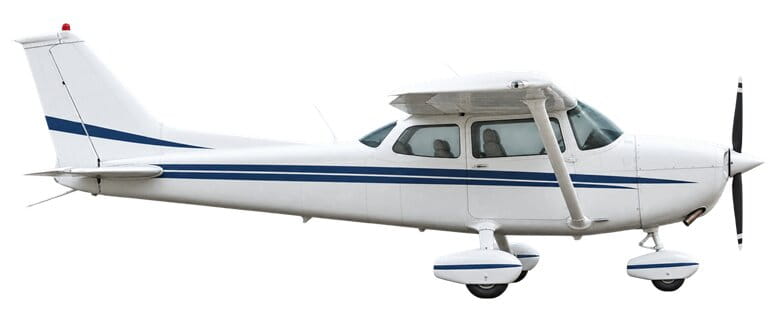
Cessna 172 Stall Simulator: Visualize Airflow and Stall

Interactive Simulator Cessna 172 Stall Aerodynamics

What happens to the airflow around a Cessna 172 as its angle of attack increases toward a stall? This free interactive simulator illustrates how a training airplane progressively approaches its critical angle of attack and how airflow separation develops over the wing.

The simulation shows the airplane gradually raising its nose while the airflow changes around the wing. It illustrates the transition from attached airflow to aerodynamic stall and highlights why pitch attitude and angle of attack are not the same thing.

Learning Objective Understand how increasing angle of attack changes airflow around a Cessna 172, recognize the development of airflow separation, and explain why exceeding the critical angle of attack causes an aerodynamic stall.
StudyFlight · Interactive flight training

Angle of Attack Flight Simulator

Raise the angle of attack and see how the airplane's attitude, airspeed, and stall margin change in a simplified level-flight example.

Cessna 172 · Side view

Wing attitude illustration

Nose-up attitude is exaggerated gradually to make the change easy to see. In flight, pitch attitude and angle of attack are not the same: AoA is measured relative to the oncoming airflow.

Flight instruments

Illustrative values
Airspeed
83
KIAS (example)
Engine power
2,300
RPM (held constant)
Altitude3,500 FTInitial level-flight example
Stall margin10°Until example critical AoA
Attached airflow. The wing is below the example critical angle of attack.

Adjust angle of attack

Move the control from 4° to the example critical angle of 18°.

8° AoA

Moderate AoA: In this level-flight example, less airspeed is needed as the wing operates at a higher lift coefficient.
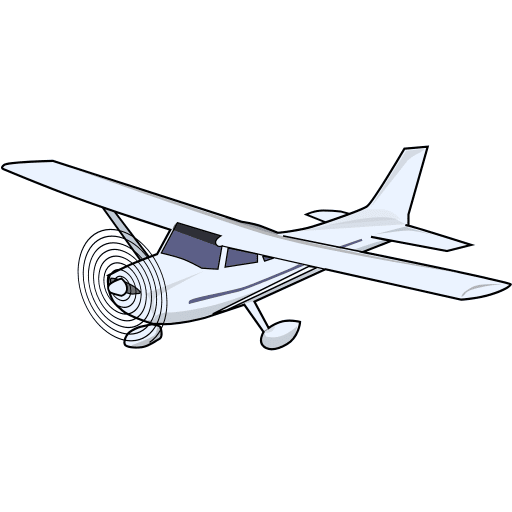
Understanding the Cessna 172 Stall Animation

The animation represents a progressive approach to a stall. As the angle of attack increases, the airflow around the wing changes. Three aerodynamic stages are particularly important.

Stage 01

Attached Airflow

At a moderate angle of attack, air follows the wing's upper surface relatively smoothly. The wing produces lift while airflow separation remains limited.

Stage 02

Approaching the Stall

As the angle of attack rises, airflow becomes increasingly vulnerable to separation. The disturbed region can begin near the rear of the upper surface and spread as the wing approaches its critical angle.

Stage 03

Beyond the Critical Angle

Once the critical angle of attack is exceeded, airflow separation becomes more significant. The wing's lift coefficient decreases, aerodynamic drag increases, and the airflow behind the wing becomes more disturbed.

Why Does the Cessna 172 Raise Its Nose?

In this simulation, the airplane progressively raises its nose to illustrate one common way of approaching a stall during flight training. This change in pitch attitude can increase the angle of attack, depending on the airplane's flight path.

However, pitch attitude and angle of attack are not the same. Pitch is measured relative to the horizon, while angle of attack is measured between the wing's chord line and the relative wind. An airplane can therefore stall without displaying an extreme nose-high attitude.

Key Principle: The wing stalls when it exceeds its critical angle of attack—not when the nose reaches a particular position relative to the horizon. The animation illustrates the aerodynamic sequence; it does not reproduce every flight condition or configuration of a Cessna 172.

Cessna 172 Stall Simulator: Key Questions

Can a Cessna 172 stall without a high nose-up attitude?

Yes. A Cessna 172 can stall at different pitch attitudes, including with its nose below the horizon. What matters is whether the wing exceeds its critical angle of attack relative to the incoming airflow.

Does a wing stop producing lift during a stall?

No. A stalled wing does not instantly lose all its lift. When airflow separates more extensively from the upper surface, the wing's lift coefficient decreases from its maximum value while drag rises.

Why can the same airplane stall at different airspeeds?

The airspeed associated with a stall depends on factors such as aircraft weight, load factor, and configuration. The critical angle of attack is the aerodynamic limit for the wing in a given configuration, so memorizing one stall speed cannot describe every flight condition.

Continue Learning About Airplane Stalls

error:
Study flight
Logo