
Imagine you are flying straight and level when a gust of wind lifts one wing or pushes the airplane's nose upward. You may need to correct the motion with the flight controls, but the airplane's design also affects what happens next. This natural response is called aircraft stability.
In aerodynamics, stability describes an airplane's tendency to resist a disturbance or return toward a balanced flight condition. A stable airplane does not necessarily return immediately or without movement. It may overshoot its original condition and oscillate before settling down.
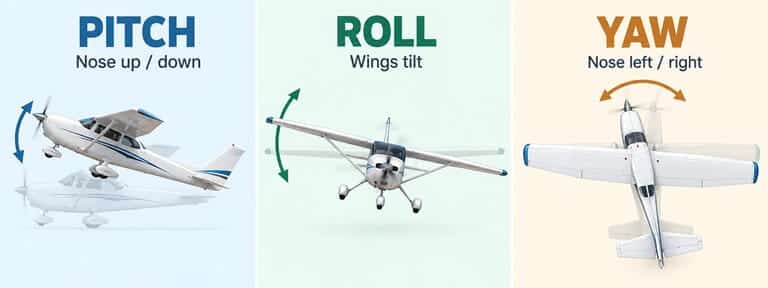
This lesson examines how an airplane responds to disturbances in pitch, roll, and yaw. We will study the difference between static and dynamic stability, explain how wing geometry and tail surfaces influence the airplane's behavior, and explore natural motions such as phugoid oscillations, Dutch roll, and spiral instability.
Understand the aerodynamic principles of aircraft stability. Learn how to distinguish an airplane's initial response from its motion over time, identify the design features that influence stability, and explain why different types of aircraft behave differently when disturbed.
Does the airplane start moving back toward its previous condition, remain in the new position, or move farther away? These reactions are used to describe static stability.
After a disturbance, the airplane may oscillate. These movements can gradually decrease, remain the same size, or increase. This behavior is known as dynamic stability.
Wing shape, tail size, and the position of aerodynamic surfaces all influence stability. Their design determines how forces and moments act on an airplane when its flight condition changes.
Why can an airplane begin to correct a disturbance, yet develop larger oscillations as time passes?
Longitudinal Stability: Pitch and the Horizontal Tail
Longitudinal stability is an airplane's natural tendency to resist an unwanted change in pitch. When something disturbs the airplane and causes its nose to rise or fall, a longitudinally stable airplane develops aerodynamic forces that tend to oppose that change. The horizontal tail plays a major role in this process.

Important distinction: The word longitudinal in “longitudinal stability” refers to pitch stability. It does not mean that the airplane pitches around its longitudinal axis. The lateral axis is the axis of rotation.
How Longitudinal Stability Works
Imagine a training airplane flying straight and level at a steady airspeed. Its aerodynamic forces and pitching moments are balanced for that flight condition. The nose is not continuously rising or falling because the total pitching moment is approximately zero.
Now imagine that the airplane encounters a disturbance. The forces may no longer be balanced, and the nose may begin to move. If the airplane has positive longitudinal static stability, the resulting aerodynamic pitching moment tends to oppose the change in its angle of attack.
If a small disturbance increases the airplane's angle of attack, a stable airplane tends to develop a nose-down restoring moment. If the disturbance decreases the angle of attack, it tends to develop a nose-up restoring moment.
This does not mean the airplane instantly returns to the same altitude or pitch attitude. It means its aerodynamic response acts against the initial change rather than encouraging it.
A pitch disturbance does not always come from turbulence. Several normal events during flight can change the forces or moments acting on the airplane.
Gusts and Turbulence
A vertical gust changes the direction of the airflow approaching the airplane. This can temporarily increase or decrease the wing's angle of attack.
The change in airflow alters lift and pitching moments. Depending on the gust and the airplane, the nose may begin to rise or fall.
Elevator Inputs
When the pilot moves the control column, the elevator changes the aerodynamic force acting near the tail.
Pulling back normally commands a nose-up pitching moment. Pushing forward normally commands a nose-down pitching moment.
Changes in Engine Power
Increasing or reducing power can change the airplane's pitching balance. One reason is the position of the thrust line relative to the center of gravity.
On propeller airplanes, a power change can also alter the airflow reaching the horizontal tail.
Flaps and Configuration Changes
Extending or retracting flaps changes the aerodynamic forces acting on the wing and can modify the airflow reaching the tail.
The airplane may therefore develop a new pitching tendency as the configuration changes.
Temporary Pitch Disturbance
A gust or brief elevator input can push the airplane away from its previous condition. Once the disturbance is removed, its natural stability determines the initial corrective tendency.
Change in Flight Balance or Stability
A sustained power or configuration change can create a different trimmed flight condition. A change in CG position or tail effectiveness can also change how strongly the airplane resists pitch disturbances.
An airplane can be longitudinally stable and still pitch when the pilot adds power or extends the flaps.
The airplane may simply be responding to a new balance of forces. Stability describes its natural response to a disturbance around a given flight condition—not its ability to remain at exactly the same pitch attitude under every circumstance.
The Role of the Horizontal Stabilizer
The horizontal stabilizer is the fixed horizontal surface located near the tail of most conventional training airplanes. It helps provide the aerodynamic balance needed for stable flight.
Because the horizontal tail is far behind the center of gravity, even a relatively small change in its aerodynamic force can produce an important pitching moment. This is one reason the horizontal tail is so effective.

1. The CG Is the Reference Point
Pitching moments are considered around the airplane's center of gravity. Forces acting at a distance from this point can make the airplane rotate.
2. The Tail Has a Long Lever Arm
The distance between the CG and the horizontal tail gives the tail considerable leverage. A relatively small force change can have a strong effect on pitch.
3. Tail Force Changes With Airflow
The force depends on airspeed, the tail's angle to the incoming airflow, elevator position, and airflow from the wing and propeller.
The horizontal stabilizer is part of the airplane's aerodynamic stability system. The elevator, attached to its trailing edge on a conventional airplane, is the primary control surface the pilot uses to command pitch changes.
Both affect the force produced near the tail, but control and stability are not the same thing.
How Restoring Pitching Moments Develop
The horizontal tail does more than help balance the airplane in normal flight. Its aerodynamic contribution also changes when the airplane's angle of attack changes.
This is the key to longitudinal static stability: a disturbance changes the aerodynamic forces, and those changes produce a net pitching moment that tends to oppose the disturbance.

Suppose a small disturbance increases the airplane's angle of attack while the elevator remains fixed.
On a conventional statically stable airplane, the tail's aerodynamic contribution generally changes in the direction of more upward force, or less downward force.
Because the tail is behind the CG, this force change contributes to a nose-down pitching moment. The combined wing, fuselage, and tail moments determine the final response.
Now suppose a small disturbance decreases the airplane's angle of attack, again with the elevator fixed.
The aerodynamic force change at the tail generally acts in the opposite direction: more downward force, or less upward force.
Because this force change acts behind the CG, it contributes to a nose-up pitching moment. Again, the response depends on the total aerodynamic moment of the airplane.
The diagrams above show the change in aerodynamic force caused by a pitch disturbance, not necessarily the total force acting on the tail.
For example, if the tail is already producing downward force, an upward change may simply mean that the downward force becomes smaller. It does not necessarily mean the tail suddenly starts lifting upward.
This distinction is important: the steady force helps balance the airplane, while the change in force helps restore its aerodynamic equilibrium after a disturbance.
The airplane's angle of attack moves away from its trimmed value.
The wing, fuselage, and horizontal tail no longer produce exactly the same pitching balance.
If the airplane is statically stable, the net moment initially opposes the change in angle of attack.
The strength of this restoring tendency depends on the airplane's aerodynamic design and the location of its center of gravity. This leads to one of the most important practical factors affecting longitudinal stability.
Why Center of Gravity Influences Longitudinal Stability
The center of gravity (CG) is the point where the airplane's total weight can be considered to act. Its position affects the balance between the aerodynamic moments created by the wings, fuselage, and horizontal tail.
Moving the CG forward or aft changes how readily the airplane develops a restoring pitching moment after a disturbance. It also changes how much elevator force may be needed to control the airplane.
Think of the CG as the reference point for pitching moments. An aerodynamic force can cause a nose-up or nose-down rotation depending on where it acts relative to that point.
When the CG moves, those relationships change—even though the airplane's wings and tail have not physically moved.
In general, moving the CG forward increases the airplane's natural tendency to resist changes in angle of attack. Moving it aft reduces that tendency.
Forward Center of Gravity
Generally More Pitch StabilityWith the CG farther forward, the airplane generally has a stronger restoring tendency after a small pitch disturbance.
However, on a conventional light airplane, the horizontal tail usually needs to produce more downward force to balance the airplane.
The elevator may therefore need to work harder to raise the nose, especially at low airspeeds.

Main trade-off: More natural pitch stability, but potentially greater elevator effort.
Aft Center of Gravity
Generally Less Pitch StabilityAs the CG moves rearward, the airplane's restoring tendency becomes weaker. Pitch changes may require less elevator force.
On a conventional light airplane, less downward balancing force is generally needed from the horizontal tail.
But a CG too far aft can greatly reduce pitch stability and make it difficult to lower the nose when necessary.

Main trade-off: Lighter pitch-control effort, but less natural restoring stability.
The illustrations above show extreme CG positions outside the approved operating limits. They are not intended to describe the normal behavior of an airplane properly loaded within its approved CG envelope.
The manufacturer establishes forward and aft CG limits to provide an acceptable balance between stability, controllability, and performance.
The following table compares the typical tendencies of a conventional light airplane as its CG moves within the approved range. The final row explains what can happen if those limits are exceeded.
| Characteristic | Forward CG | Aft CG |
|---|---|---|
| Longitudinal Static Stability | Generally greater. The airplane has a stronger tendency to oppose a small pitch disturbance. | Generally reduced. The restoring tendency becomes weaker. |
| Horizontal Tail Balance | Typically requires more downward tail force in steady flight. | Typically requires less downward tail force for the same flight condition. |
| Elevator Effort | More nose-up control force may be needed, particularly at lower airspeeds. | Less control force may be needed; pitch response can feel more sensitive. |
| Response to a Disturbance | Generally a stronger initial aerodynamic restoring moment. | Generally a weaker initial aerodynamic restoring moment. |
| Stall Speed Tendency | Often higher because additional tail downforce requires the wing to produce more lift. | Often somewhat lower because less balancing tail downforce may be required. |
| If the CG Is Outside Its Limit | Excessively forward CG can prevent sufficient nose-up elevator authority for takeoff rotation or landing flare. | Excessively aft CG can cause very poor pitch stability and insufficient nose-down authority for stall recovery. |
No. Greater stability is not the same as greater safety in every situation.
A very forward CG may make the airplane harder to rotate during takeoff or flare during landing. A very aft CG may make it difficult to control pitch or recover from a stall.
The safest condition is not simply “as far forward as possible.” It is a CG position that remains within the manufacturer's approved limits for the airplane's weight and operating condition.
Longitudinal stability is the airplane's tendency to oppose an unwanted change in pitch. Gusts, elevator inputs, power changes, and configuration changes can disturb its pitching balance. The horizontal tail helps produce the aerodynamic moments that resist these disturbances. A forward CG generally increases pitch stability, while an aft CG generally reduces it. The airplane must always remain within its approved CG limits.

Lateral Stability: Roll and the Dihedral Effect
Lateral stability is an airplane's natural tendency to resist an unwanted rolling motion. If a disturbance causes one wing to drop, the airplane's aerodynamic design can help produce a rolling moment that tends to raise that wing again. One of the most important design features contributing to this behavior is wing dihedral.
What Is Lateral Stability?
Lateral stability concerns the airplane's behavior in roll, the movement in which one wing rises while the other descends. This rotation takes place around the longitudinal axis, an imaginary line running from the nose to the tail.
The pilot uses the ailerons to command rolling movements. However, the ailerons are not what make the airplane naturally stable. Lateral stability comes from the aerodynamic effects of the wings and other parts of the airplane when it encounters disturbances.

The names describe two different things. Lateral stability identifies the type of stability: stability in roll. The longitudinal axis identifies the line around which that rolling movement occurs.
In other words, lateral stability is stability about the longitudinal axis.
What Causes an Unwanted Roll?
A gust of wind, wake turbulence, or another uneven aerodynamic force can make one wing rise or fall unexpectedly. The airplane may begin to bank even though the pilot has not commanded a turn.
What Does Stability Contribute?
If the disturbance produces a sideslip, the airplane's design may create an aerodynamic rolling moment that opposes the initial bank. This tendency can help the pilot maintain control, although corrections may still be necessary.
The important question is not simply whether the airplane has banked. It is how the airflow around the wings changes after the disturbance. This is where wing dihedral becomes important.
How Wing Dihedral Produces a Restoring Rolling Moment
Dihedral is the upward angle of an airplane's wings when viewed from the front. On an airplane with positive dihedral, the wingtips are higher than the points where the wings attach to the fuselage.
Dihedral does not produce its stabilizing effect simply because the wings point upward. Its main contribution becomes apparent when the airplane experiences a sideslip, meaning that the relative airflow approaches partly from one side instead of directly ahead.
Imagine the airplane is disturbed and one wing drops. The airplane may begin moving slightly sideways toward the lower wing. The relative wind then approaches from that side.
Because the wings have dihedral, this sideways airflow affects them differently. The wing facing the incoming airflow tends to experience a higher effective angle of attack, while the opposite wing experiences a lower effective angle of attack.
A gust or another disturbance produces an unexpected rolling motion and the airplane banks.
The airplane begins moving sideways relative to the air. The relative wind approaches partly from the lower-wing side.
With positive dihedral, the windward wing tends to gain effective angle of attack and lift relative to the opposite wing.
The difference in lift tends to raise the lower, windward wing and oppose the rolling disturbance.
Sideslip → Different effective angles of attack → Different lift on each wing → Rolling moment. With positive dihedral effect, that rolling moment tends to raise the windward wing.
Not in every situation. Dihedral creates a stabilizing rolling response primarily when there is sideslip.
An airplane can remain banked during a properly coordinated turn, even if it has positive dihedral. Dihedral does not act like an automatic wings-level control system.
It is one part of the airplane's overall aerodynamic behavior. The pilot still uses the ailerons to establish, adjust, or remove the desired bank angle.
How Wing Position and Sweepback Affect Lateral Stability
An airplane does not need large, visibly upward-angled wings to have a useful stabilizing response in roll. Its wing position and sweepback can also influence the rolling moment produced during a sideslip.
Aerodynamicists use the term effective dihedral to describe the combined influence of geometric dihedral and other design features on this response. The actual effect depends on the complete airplane, not just the wing angle visible from the front.
High-Wing Airplanes
On a high-wing airplane, the wings are mounted near the upper part of the fuselage.
During a sideslip, aerodynamic interactions between the wings, fuselage, and sideways airflow can contribute to a positive dihedral effect.
For this reason, some high-wing airplanes need less geometric dihedral than a comparable low-wing design.
Low-Wing Airplanes
On a low-wing airplane, the wings are attached near the lower part of the fuselage.
This wing position generally provides less positive effective dihedral than a high-wing arrangement, with other design factors unchanged.
Designers may therefore use more visible geometric dihedral to obtain the desired rolling response to sideslip.
Sweptback Wings
On a sweptback wing, the wings angle rearward from the fuselage rather than extending straight outward.
During a sideslip, the wing facing the incoming airflow experiences a smaller effective sweep angle. At a positive lift coefficient, it tends to produce more lift than the opposite wing.
This difference can create a stabilizing rolling moment, even without a large geometric dihedral angle.
The idea of the fuselage hanging beneath the wings like a pendulum can be a useful first visual analogy, but it is not a complete aerodynamic explanation.
The stabilizing effect of wing position depends substantially on how the wing, fuselage, and surrounding airflow interact during a sideslip. A high-wing configuration is therefore not automatically more stable in every flight condition.
| Design Feature | What It Changes | Typical Influence on Roll Stability |
|---|---|---|
| Positive Geometric Dihedral | Wingtips are higher than wing roots. | Usually provides a positive rolling response to sideslip, tending to raise the windward wing. |
| High-Wing Position | Wing is mounted high on the fuselage. | Often adds positive effective dihedral through wing-fuselage aerodynamic interactions. |
| Low-Wing Position | Wing is mounted low on the fuselage. | Usually contributes less positive effective dihedral than a comparable high-wing arrangement. |
| Wing Sweepback | Wings angle backward from the fuselage. | Usually adds a positive dihedral effect during sideslip when the wings are producing positive lift. |
| Anhedral | Wingtips angle downward rather than upward. | Can reduce an excessive positive dihedral effect produced by other design features. |
Some airplanes use anhedral, meaning that the wingtips angle downward when viewed from the front.
This may seem surprising, but an airplane can already have a strong positive dihedral effect because of its wing position or sweepback. Adding anhedral can help reduce that overall effect to the level desired by the designer.
The goal is not to maximize one stability feature in isolation. It is to achieve appropriate flying characteristics for the complete airplane.
Lateral stability concerns roll around the longitudinal axis. Wing dihedral contributes to this stability by creating a difference in lift between the wings during a sideslip. The windward wing generally develops more lift, creating a rolling moment that tends to raise it. Wing position and sweepback can also contribute to the overall dihedral effect. Dihedral helps stabilize an airplane, but it does not automatically keep the wings level in every situation.
Directional Stability: Yaw and the Vertical Tail
Directional stability is an airplane's natural tendency to resist an unwanted change in yaw. When the nose is no longer aligned with the approaching airflow, the airplane can develop an aerodynamic moment that tends to correct this misalignment. The vertical tail is the main part of a conventional airplane responsible for this stabilizing effect.
How Directional Stability Works
Directional stability concerns movement around the vertical axis. This movement is called yaw. The airplane's nose moves left or right as the aircraft rotates around an imaginary vertical line passing through its center of gravity.
The pilot uses the rudder to command yaw. However, the airplane also has natural aerodynamic characteristics that influence how it responds when airflow approaches from the side.

Three terms are important when studying directional stability. They are related, but they do not mean the same thing.
Yaw — A Movement
Yaw occurs when the airplane rotates around its vertical axis. The nose turns left or right.
Sideslip — An Airflow Condition
Sideslip occurs when the relative airflow approaches the airplane partly from one side instead of being aligned with its nose.
Directional Stability — A Response
Directional stability is the tendency to produce a yawing moment that reduces the airplane's misalignment with the relative airflow.
Imagine an airplane moving forward when a sudden disturbance turns its nose slightly to the right.
The airplane's direction of travel does not change instantly. For a short time, the nose points slightly right of the direction in which the airplane is moving.
The relative airflow now approaches partly from the left side. This creates a sideslip, allowing the vertical tail to produce a correcting yawing moment.
The Role of the Vertical Stabilizer
The vertical stabilizer is the fixed upright surface located at the rear of a conventional airplane. It is often called the vertical fin.
Its main stabilizing role is to produce an aerodynamic side force when airflow reaches it at an angle. Because the vertical fin is behind the center of gravity, this side force can create a moment that turns the airplane's nose toward the approaching airflow.

The vertical fin is shaped to interact with moving air. When the relative airflow approaches it from the side, the pressure distribution around the fin changes.
This creates a sideways aerodynamic force. The direction of the force depends on which side the airflow comes from.
Because the force acts at the rear of the airplane, it produces a yawing moment around the CG. For a directionally stable airplane, this moment tends to reduce the sideslip angle.

The distance between the CG and the vertical tail is called the tail moment arm. It gives the vertical fin leverage to turn the airplane around its vertical axis.
The Airplane Experiences Sideslip
The relative airflow begins approaching the airplane from one side instead of directly ahead.
The Vertical Fin Creates a Side Force
The airflow acts on the vertical tail and generates a sideways aerodynamic force behind the CG.
The Nose Turns Toward the Airflow
The resulting yawing moment tends to reduce the sideslip and align the airplane with the relative wind.
No. The restoring force depends on several aerodynamic conditions. At a higher airspeed, the vertical fin can generally produce a stronger aerodynamic force for the same sideslip angle.
At low airspeed, the force is usually weaker. Very large sideslip angles or disturbed airflow can also reduce the effectiveness of the fin.
This means directional stability is a natural aerodynamic tendency, not a guarantee that an airplane can resist every possible yawing disturbance.
Vertical Tail Size
The size and shape of the vertical stabilizer influence how much aerodynamic side force it can produce.
Distance Behind the CG
The greater the tail moment arm, the more leverage the force has to produce a yawing moment.
Airflow at the Tail
Airspeed, sideslip angle, and airflow disturbed by the aircraft can change the fin's effectiveness.
How an Aircraft Responds to a Sideslip
We have seen that the vertical tail develops a side force when the relative airflow reaches it at an angle.
The direction of the restoring moment depends on which side the airflow approaches from. The two examples below show how the same aerodynamic mechanism works in opposite directions.
Airflow from the left creates a force toward the right on the vertical stabilizer.
Because the tail is behind the CG, this force creates a nose-left yawing moment.
The moment tends to turn the nose toward the approaching airflow and reduce the sideslip.
Airflow from the right creates a force toward the left on the vertical stabilizer.
Because the force acts behind the CG, it creates a nose-right yawing moment.
Again, the moment tends to turn the nose toward the approaching airflow and reduce the sideslip.
The side force changes direction when the sideslip changes direction. A directionally stable airplane develops a yawing moment that opposes the misalignment with the relative airflow.
Not necessarily. This is an important point for pilots to understand.
Directional stability helps the airplane align with the relative airflow. It does not automatically restore the exact compass heading the airplane had before the disturbance.
Once the sideslip has decreased, the airplane may be flying on a slightly different heading. The pilot must still maintain or reestablish the intended direction of flight.
Directional stability and lateral stability are separate aerodynamic characteristics, but both can be influenced by sideslip. Their interaction will be explained in the next chapter.
Directional stability concerns yaw around the vertical axis. During sideslip, the vertical stabilizer produces an aerodynamic side force behind the center of gravity. This creates a restoring yawing moment that tends to turn the nose toward the approaching airflow. The fixed vertical stabilizer contributes to natural stability, while the rudder allows the pilot to command yaw. Directional stability reduces the tendency to remain in sideslip, but it does not guarantee a return to the original heading.

Aircraft Stability vs Maneuverability and Controllability
An airplane must be stable enough to fly safely, but it must also respond when the pilot wants to change direction. These two needs are not always easy to combine. An airplane designed for basic flight training does not need the same handling characteristics as an airplane designed for aerobatics.
Why More Stability Is Not Always Better
To understand the difference, we need to separate three important characteristics. They are related, but they do not mean the same thing.
Stability
The tendency of an airplane to remain in steady flight or return toward it after a disturbance.
Maneuverability
How easily and quickly an airplane can change its flight path or attitude.
Controllability
How well the airplane responds to the pilot's control inputs.
Think about this: An airplane with strong stability tends to resist changes from steady flight. That can make it easier to manage during normal flying. However, if the airplane resists changes too strongly, the pilot may need more control force to maneuver it.
Aircraft designers therefore look for the right balance. The ideal balance depends on what the airplane is expected to do.
Stability in Training Airplanes vs Aerobatic Aircraft
The Cessna 172 Skyhawk and the Extra 330LX are useful examples because they were designed for different types of flying.
Cessna 172 Skyhawk
Training Aircraft
The Cessna 172 is widely used to teach new pilots. Its predictable flight characteristics help students learn to control the airplane during climbs, turns, descents, and landings.
During normal flight, its controls are designed to provide manageable responses rather than the very rapid movements needed for advanced aerobatics.
Extra 330LX
Aerobatic Aircraft
The Extra 330LX is designed for aerobatic flying. It can perform rapid rolls, loops, and other advanced maneuvers within its approved flight limits.
Its responsive flight controls allow an experienced pilot to make quick and precise changes in the airplane's attitude.
Training Aircraft vs Aerobatic Aircraft: Key Differences
| Characteristic | Cessna 172 | Extra 330LX |
|---|---|---|
| Primary Purpose | Flight training and normal flying | Aerobatic training and performance |
| Control Response | Generally smooth and progressive | Designed for quick, precise responses |
| Maneuverability | Suited to normal flight maneuvers | Suited to rapid and advanced maneuvers |
| Pilot Experience | Suitable for student pilots | Requires specialized aerobatic training |
| Design Priority | Ease of learning and predictable handling | Aerobatic performance and precise control |
Important: An aerobatic airplane is not automatically unstable. Stability and maneuverability are different characteristics. An airplane can be highly maneuverable and still have positive stability.
Why Pilots Must Understand Aircraft Stability
Imagine a pilot who has learned to fly in a Cessna 172 and is now beginning aerobatic training in an Extra 330LX. The pilot already knows how to use the ailerons, elevator, and rudder. However, the new airplane may respond differently to the same type of control input.
In the Cessna 172
The pilot makes a small aileron input to begin a turn. The airplane responds in a generally progressive way, giving the student time to observe the bank and adjust the controls.
In the Extra 330LX
The pilot must be prepared for a more responsive airplane. A control input can produce a quicker change in attitude, so precise control movements are especially important.
The exact response of either airplane also depends on airspeed, flight conditions, and the size of the control input. For that reason, pilots must learn the handling characteristics of each aircraft they fly.
What Does This Mean for a Pilot?
Before flying a different aircraft, a pilot should understand how its controls respond, what maneuvers it is approved to perform, and what training is required. Experience in one airplane does not automatically prepare a pilot to fly every other airplane.
If you need to review how the flight controls produce pitch, roll, and yaw, see our lesson on aircraft attitudes and movements .
Stability helps an airplane maintain steady flight. Maneuverability allows it to change its flight path. Controllability allows the pilot to command those changes. Aircraft designers balance these characteristics according to the airplane's purpose.