Aircraft Magnetic Compass: How It Works, Dip & Errors

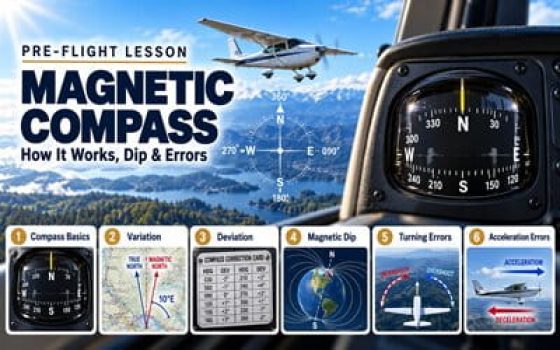
Aircraft magnetic compass pre-flight lesson showing compass basics, magnetic variation, deviation, magnetic dip, turning errors, and acceleration errors.
Pre-Flight Lesson Instrument Flying
Lesson Objective

Learn how to read and use an aircraft magnetic compass and understand the errors that can affect its indications.

You will learn how magnetic variation and compass deviation affect headings, why magnetic dip causes turning and acceleration errors, and how to recognize unreliable compass readings during flight.

01 / Understand Know the Compass Basics

Learn how the magnetic compass works, how to read its compass card, and how it shows the airplane's magnetic heading.

02 / Correct Understand Heading Corrections

Learn the difference between magnetic variation and deviation, and how to use a compass correction card.

03 / Recognize Recognize Compass Errors

Understand magnetic dip, turning errors, and acceleration errors so you can recognize misleading compass indications.

Why Learn the Aircraft Magnetic Compass?

Modern airplanes often use electronic flight instruments, but the traditional magnetic compass remains an important source of heading information. It works without relying on the aircraft's electrical system and can provide an independent heading reference.

Reading a magnetic compass is not always as simple as it looks. The compass can give misleading indications when the airplane turns, accelerates, or decelerates. These errors are especially important when a pilot must rely on the compass to maintain or change heading.

This lesson uses simple explanations, clear diagrams, and practical flight examples to help you understand the magnetic compass, recognize its limitations, and use it correctly in the airplane.

Magnetic Compass Basics

How Does an Aircraft Magnetic Compass Work?

An aircraft magnetic compass is a flight instrument that shows the direction the airplane is pointing relative to magnetic north. It uses the Earth's magnetic field and does not need electrical power to operate.

Inside a traditional compass, small permanent magnets are attached to a floating assembly. The magnets align with the Earth's magnetic field, while the airplane and compass housing can turn around them. A graduated compass card allows the pilot to read the airplane's magnetic heading.

Three Main Parts of a Magnetic Compass

01 / Direction

Magnets and Float

Small magnets are attached to a float supported by a pivot. They align with the Earth's magnetic field and provide the compass with its directional reference.

02 / Indication

Compass Card

A graduated card is attached to the floating assembly. It has letters and numbers representing directions from 0° to 360°. The pilot reads the card through the front window.

03 / Stability

Compass Fluid

The compass housing contains a special fluid that supports the float and reduces unwanted oscillations. This helps the card settle so the pilot can read the indicated heading.

How to Read an Aircraft Magnetic Compass

A traditional magnetic compass has a fixed vertical reference mark called the lubber line. This line is attached to the compass housing and represents the direction of the airplane's nose.

To find the indicated magnetic heading, read the compass card directly behind the lubber line.

Traditional aircraft magnetic compass showing the fixed lubber line and compass card with 6, 3 and N markings
Traditional aircraft magnetic compass. The fixed vertical lubber line is used to read the heading.
1
Find the Lubber Line

Look for the fixed vertical reference line in the center of the compass window.

2
Read the Compass Card

Read the letter or number aligned with the lubber line. On a typical compass, the numbers omit the final zero.

3
Identify the Heading

For example, a reading of 3 means 030° magnetic. A reading of 24 means 240° magnetic.

Why Does the Compass Card Look Backward?

When you look at a traditional aircraft magnetic compass, the numbers appear in the opposite order from a normal compass rose.

This happens because the pilot views the back of the rotating compass card. The card stays aligned with the Earth's magnetic field while the airplane turns around it.

Reading the Compass Card — 030° Example

The diagram below shows a simplified traditional compass card. The fixed lubber line is aligned with the number 3.

6 3 N 33 FIXED LUBBER LINE 030° MAG

Simplified compass display. The number 3 is aligned with the fixed lubber line, so the indicated magnetic heading is 030°.

N 360° / 000°
3 030°
6 060°
33 330°
Important — The Compass Shows Heading, Not Ground Track

The magnetic compass indicates the direction the airplane's nose is pointing. This is its magnetic heading.

Wind can push the airplane sideways, causing its actual path over the ground to differ from its heading. That path is called ground track.

Also remember that the compass may give misleading indications during turns and changes in airspeed. These errors will be explained later in this lesson.

Key Point

A traditional aircraft magnetic compass uses magnets aligned with the Earth's magnetic field. Read the heading at the fixed lubber line, remembering that the compass card appears reversed. The instrument shows magnetic heading, not the airplane's track over the ground.

Magnetic Direction

True North, Magnetic North and Magnetic Variation

When navigating an airplane, pilots use two different references: true north and magnetic north. These directions are not usually the same.

The angular difference between them is called magnetic variation. Pilots must understand this difference when converting directions measured from true north into magnetic directions used for navigation.

True North vs. Magnetic North

Geographic Reference True North

True north is the direction toward the Earth's geographic North Pole. It follows the Earth's geographic coordinate system.

Lines of longitude on a geographic map are referenced to true north.

Magnetic Reference Magnetic North

Magnetic north is the direction indicated by the horizontal component of the Earth's local magnetic field.

A traditional aircraft compass aligns with this magnetic field, rather than directly with geographic north.

What Is Magnetic Variation?

Magnetic variation is measured in degrees east or west, depending on the position of magnetic north relative to true north at your location.

If magnetic north lies to the east of true north, the location has easterly variation. If it lies to the west, the location has westerly variation.

15° E TRUE NORTH MAGNETIC NORTH COURSE Observer
Example of 15° East magnetic variation. Magnetic north is 15° clockwise from true north. The same course measures 060° true and 045° magnetic.
Example: 15° East Variation

Imagine an airplane planning a course of 060° true in an area with 15° East variation.

Magnetic north is 15° clockwise from true north, so the course measured from magnetic north is 15° smaller.

True Course 060°
Magnetic Course 045°

060° − 15° = 045°

The direction over the ground has not changed. Only the reference used to measure its angle is different.

How to Convert True to Magnetic Direction

During flight planning, you may need to convert a true course into a magnetic course. The rule depends on whether the local variation is east or west.

East Variation

Subtract East Variation

When converting from true to magnetic, subtract easterly variation.

True − East = Magnetic
Example: 15° East Variation 060° − 15° = 045°

A true course of 060° becomes a magnetic course of 045°.

West Variation

Add West Variation

When converting from true to magnetic, add westerly variation.

True + West = Magnetic
Example: 12° West Variation 120° + 12° = 132°

A true course of 120° becomes a magnetic course of 132°.

Remember — Reverse the Rule When Converting Magnetic to True

The examples above convert true directions to magnetic directions.

To convert in the opposite direction, from magnetic to true, reverse the operations: add East variation and subtract West variation.

For example, with 15° East variation, a magnetic direction of 045° becomes 060° true (045° + 15°).

Where Do Pilots Find Magnetic Variation?

Magnetic variation changes with geographic location and gradually changes over time. Pilots should therefore use appropriate current aeronautical chart information rather than assuming one variation value applies everywhere.

FAA Aeronautical Charts Isogonic Lines

Aeronautical charts may show curved lines called isogonic lines. These connect locations with equal magnetic variation.

The variation is identified by a value such as 10° E or 8° W. A line connecting locations with zero variation is called an agonic line.

For more information on aeronautical charts and planning a route, see the StudyFlight VFR Navigation lesson .

Important — Variation Is Not Compass Deviation

Magnetic variation comes from the Earth's magnetic field and depends on your location.

The compass installed in an airplane can also be affected by magnetic fields produced within the aircraft. This separate error is called compass deviation. We will examine it in the next section.

Key Point

Magnetic variation is the angular difference between true north and magnetic north. When converting a true direction to magnetic, subtract East variation and add West variation. Reverse these operations when converting magnetic to true. Use appropriate current chart information to determine the variation for your location.

Compass Accuracy

Compass Deviation and the Correction Card

An aircraft magnetic compass can be affected by magnetic fields produced by the airplane itself. Metal parts and electrical equipment can interfere with its indication.

This error is called compass deviation. It varies from one airplane to another and can change with the heading.

During maintenance, a qualified technician adjusts the compass to reduce this error. Any remaining error is recorded on a compass correction card.

Where Can You Find the Compass Correction Card?

The compass correction card is normally mounted on or near the magnetic compass in the cockpit. Look for a small card attached to the compass housing, its holder, or the nearby instrument panel.

Before flight: Locate the correction card in your airplane. It belongs to that specific aircraft. You must use its corrections, not those from another airplane.

How to Read a Compass Correction Card

The card tells you what the compass should indicate to fly a desired magnetic heading.

It has two rows: FOR (MAGNETIC) and STEER (COMPASS).

Aircraft compass correction card showing FOR magnetic headings and corresponding STEER compass indications
Compass correction card: find the desired magnetic heading under FOR and the corresponding compass reading under STEER.

First, find the heading you want under FOR (MAGNETIC). Then read the corresponding number directly below it under STEER (COMPASS).

Practical Example: Flying East

You want to fly a magnetic heading of 090° (East).

On the correction card, find E in the FOR row. Directly below it, the STEER row shows 086°.

Reading the Correction Card
FOR (Magnetic) 090° The heading you want to fly
STEER (Compass) 086° The reading to hold on your compass

Result: With this correction card, you would hold 086° on the magnetic compass to fly approximately 090° magnetic in steady, level flight.

Other headings may need different corrections. Always read the value shown on your aircraft's card.

Key Point

Compass deviation is an error caused by magnetic interference within the aircraft.

Find the compass correction card on or near the magnetic compass. Use the FOR row to find your desired magnetic heading, then the STEER row to find the compass reading you should hold.

Pilot Resources

Pilot Supplies & Training Essentials

Explore Pilot Mall →
Magnetic Compass Errors

What Is Magnetic Dip in Aviation?

The Earth's magnetic field does not always run horizontally along the surface of the Earth. Its magnetic field lines are inclined at different angles depending on your location.

In the Northern Hemisphere, the magnetic field points both toward magnetic north and downward into the Earth. This downward inclination is called magnetic dip.

Why Does the Earth's Magnetic Field Dip?

Near the magnetic equator, the Earth's magnetic field is almost horizontal. As you move closer to the magnetic poles, the field becomes increasingly steep.

In the Northern Hemisphere, the north-seeking end of a magnetic compass is pulled downward. In the Southern Hemisphere, the south-seeking end tends to dip downward instead.

Magnetic Dip in the Northern Hemisphere NORTHERN HEMISPHERE Horizontal part Downward part Dip angle Earth's magnetic field Direction of magnetic north →
Magnetic dip is the angle between the Earth's magnetic field and the horizontal plane. In the Northern Hemisphere, the field points toward magnetic north and downward.

Why Does Magnetic Dip Affect an Aircraft Compass?

The magnets inside the compass try to align with the Earth's magnetic field. However, the compass card must remain nearly horizontal to provide useful heading readings.

To help keep the card level, the floating compass assembly is balanced with its center of gravity below its pivot point.

During a turn, acceleration, or deceleration, the forces acting on this assembly can combine with magnetic dip and cause the compass to show a temporarily misleading heading.

What Does This Mean for the Pilot?

The compass is most reliable when the airplane is flying straight and level at a constant speed, after allowing the card to settle.

During turns or changes in speed, do not assume that every movement of the compass card represents an actual change in heading.

Key Point

Magnetic dip is the inclination of the Earth's magnetic field relative to the horizontal. It affects the traditional aircraft magnetic compass and contributes to errors during turns, acceleration, and deceleration.

Magnetic Compass Errors

Magnetic Compass Turning Errors (UNOS)

During a turn, an aircraft's magnetic compass may show a heading that is different from the airplane's actual heading. This is called a magnetic compass turning error.

As we learned in the previous section, magnetic dip affects the compass magnets. When the airplane banks, this effect can cause the compass card to move faster or slower than the airplane is actually turning.

What Happens to the Compass During a Turn?

The error is especially noticeable when turning through northerly or southerly headings. It is much smaller near east and west headings.

Aircraft magnetic compass turning errors caused by magnetic dip during banked turns
Magnetic dip affects the compass card during banked turns. The compass may temporarily indicate a different heading from the airplane's actual heading.

Turning From North vs. South

In the Northern Hemisphere, the compass behaves differently when an airplane begins a turn from a northerly heading compared with a southerly heading.

Turning From North The Compass Lags

When an airplane begins turning from a northerly heading, the compass may initially indicate a turn in the opposite direction.

It then begins moving in the correct direction, but lags behind the airplane's actual turn.

Turning From South The Compass Leads

When an airplane begins turning from a southerly heading, the compass moves in the correct direction.

However, it may indicate more turn than the airplane has actually made.

Diagram comparing magnetic compass turning errors associated with north and south headings in the Northern Hemisphere
Comparison of magnetic compass turning errors associated with northerly and southerly headings in the Northern Hemisphere.

UNOS: Undershoot North, Overshoot South

When using a magnetic compass to turn toward north or south, pilots must allow for these errors.

In the Northern Hemisphere, remember the rule UNOS: Undershoot North, Overshoot South.

UN — Undershoot North Turning Toward North

When turning toward a northerly heading, begin rolling out before the compass reaches the desired heading.

Do not wait until the compass indicates north to start leveling the wings.

Flight Example

You are flying east on a heading of 090° and want to turn left toward north (360°).

Begin rolling out early, before the compass reaches the north indication.

OS — Overshoot South Turning Toward South

When turning toward a southerly heading, allow the compass to indicate past the desired heading before completing the rollout.

The compass may show south before the airplane has actually reached it.

Flight Example

You are flying east on a heading of 090° and want to turn right toward south (180°).

Allow the compass indication to pass south before completing the rollout.

Important — UNOS Applies to the Northern Hemisphere

These turning-error corrections are for the Northern Hemisphere. The effects reverse in the Southern Hemisphere and become very small near the magnetic equator.

The amount of error also depends on latitude and the conditions of the turn. UNOS is a memory aid, not a fixed correction angle for every airplane or every turn.

When a reliable heading indicator is available, use it to monitor turns rather than relying on the magnetic compass alone. Allow the compass to settle in steady, level flight before checking the heading.

Key Point

Magnetic dip causes the compass to give misleading indications during turns. Turning errors are most noticeable near north and south.

In the Northern Hemisphere, remember UNOS: Undershoot North, Overshoot South. Begin rolling out early when turning toward north, and allow for a later rollout when turning toward south.

Magnetic Compass Errors

Magnetic Compass Acceleration and Deceleration Errors (ANDS)

A magnetic compass can show a temporary false heading when the airplane accelerates or decelerates in straight flight.

In the Northern Hemisphere, this error is strongest on east and west headings. It is much smaller on north and south headings.

What Does the Compass Do?

When the airplane accelerates, the compass tends to indicate a turn toward north. When the airplane decelerates, it tends to indicate a turn toward south.

Color diagram showing magnetic compass acceleration and deceleration errors in aviation
Acceleration and deceleration can make the magnetic compass indicate a temporary heading change even when the airplane remains in straight flight.

Simple Diagram: East Heading Example

The diagram below shows an airplane flying straight on an east heading of 090°. The airplane does not turn, but the compass indication changes when speed changes.

Compass Error While Flying 090° Magnetic N S E W Actual flight path — 090° Acceleration Compass swings north Deceleration Compass swings south Acceleration Compass indicates toward north Deceleration Compass indicates toward south
Example on an east heading: the airplane continues straight, but the compass indicates a temporary movement toward north during acceleration and toward south during deceleration.

Remember ANDS

A — Acceleration Accelerate North Compass swings toward North

When the airplane accelerates on an east or west heading, the compass indicates a turn toward north.

D — Deceleration Decelerate South Compass swings toward South

When the airplane decelerates on an east or west heading, the compass indicates a turn toward south.

Practical Example

Flying Straight on 090°

Imagine that you are flying straight and level on a heading of 090°.

If you add power and accelerate, the compass may temporarily indicate a turn toward north. If you reduce power and decelerate, it may temporarily indicate a turn toward south.

In both cases, the airplane may still be flying straight. The compass indication is only a temporary error caused by acceleration or deceleration.

Important

ANDS applies in the Northern Hemisphere. In the Southern Hemisphere, the effect is reversed.

These errors become much smaller near the magnetic equator. Always let the compass settle in straight, level flight before relying on its indication.

Key Point

On east and west headings in the Northern Hemisphere, acceleration makes the compass indicate toward north, and deceleration makes it indicate toward south.

Remember ANDS: Accelerate North, Decelerate South.

Compass Limitations

Oscillation and Magnetic Compass Limitations

A traditional aircraft magnetic compass does not always show a steady heading. Its compass card may move back and forth before settling.

This movement is called compass oscillation. It can make the heading difficult to read, especially when the airplane is moving through turbulence or changing direction.

Why Does the Compass Oscillate?

The compass card is attached to a floating assembly. When the airplane moves, the card may swing for a short time before becoming steady again.

The fluid inside the compass helps slow this movement. This is called damping. However, the fluid cannot prevent every movement of the compass card.

When Is the Magnetic Compass Less Reliable?

The magnetic compass is easiest to read during straight, level flight at a constant speed. Some flying conditions can make its indications less reliable.

01 Turbulence

In rough air, the compass card may shake or move back and forth. This makes it harder to read a steady heading.

02 Steep Turns

During a steep turn, the compass card can move beyond its normal operating range. Its indications may become inaccurate or unpredictable.

03 After a Maneuver

After a turn or a change in speed, the compass may need time to settle. Wait for a steady reading before checking your heading.

Checking the Magnetic Compass Before Flight

During your preflight inspection, check that the magnetic compass is in good condition. Follow your aircraft checklist and look for these three things.

CHECK 01 Compass Fluid

Look for fluid leaks or large bubbles inside the compass. The fluid should be clear enough to read the card.

CHECK 02 Compass Card

Make sure the markings are easy to read. Check that the compass gives a reasonable indication of the airplane's direction.

CHECK 03 Correction Card

Make sure the compass correction card is present near the instrument and that you can read its corrections.

Before Flight

If you notice a fluid leak, a large bubble, a damaged compass, or an unusual indication, have the problem checked before flying.

Magnetic Compass vs. Heading Indicator

Both instruments show the direction the airplane is pointing, but they work differently. Each has advantages and limitations.

Magnetic Reference Magnetic Compass Works without electrical power

The magnetic compass uses the Earth's magnetic field to indicate heading.

It provides an independent heading reference, but its readings can be difficult to follow during turns or changes in speed.

Gyroscopic Reference Heading Indicator Easier to follow during turns

A traditional heading indicator uses a gyroscope to show heading. It provides a more stable indication during turns.

However, it can slowly drift away from the correct heading and must be checked against the magnetic compass.

When Should You Check the Heading Indicator?

In an airplane with a traditional heading indicator that requires manual adjustment, compare it with the magnetic compass regularly during flight.

Fly straight and level at a steady speed. Wait until the compass card settles, then compare the two headings. If needed, adjust the heading indicator using your aircraft's procedures.

Pilot Tip

Do not adjust a traditional heading indicator using a magnetic compass reading that is still moving after a turn or a speed change.

Some modern aircraft have electronic heading systems that use automatic magnetic information. Follow the procedures for the equipment installed in your airplane.

Key Point

The magnetic compass is most useful when the airplane is flying straight and level at a constant speed. Wait for the compass card to settle before reading the heading.

Check the compass during your preflight inspection. When using a traditional heading indicator, compare it regularly with a steady magnetic compass indication.

Practical Flight Skills

How to Use a Magnetic Compass in Flight

The magnetic compass helps you check and maintain your airplane's magnetic heading during flight.

To use it correctly, you need to know which heading to fly, read the compass when it is steady, and check that your airplane is following the planned route.

Three Steps for Using the Magnetic Compass

1 Know Your Heading

Determine the magnetic heading you need to fly, including any wind correction. Check your aircraft's compass correction card to find the proper compass reading.

2 Read the Compass

Fly straight and level at a steady speed. Allow the compass card to settle, then read the heading at the fixed lubber line.

3 Check Your Direction

Maintain your selected heading using the appropriate flight references. Check your route with visual landmarks or navigation equipment. Correct for wind drift when necessary.

Practical Example: Flying with a Crosswind

Imagine you are planning to follow a magnetic course of 090° (East).

However, the wind is blowing from the north and pushing your airplane toward the south. If you point the nose exactly east, the airplane may drift away from your intended route.

To stay on course, you must point the nose slightly into the wind. This is called a wind correction angle.

Heading vs. Ground Track N S W E 10° Heading 080° Ground track 090° Wind from north Example only: actual wind correction depends on wind and airspeed.
A crosswind can make the airplane's heading different from its ground track. In this example, a heading of 080° maintains an eastbound track of 090°.
What Should the Pilot Do?

Suppose your flight plan calls for a magnetic course of 090°. With this particular crosswind, a magnetic heading of 080° keeps the airplane on course.

Magnetic Heading 080° Direction the nose points
Magnetic Ground Track 090° Direction traveled over the ground

The magnetic compass helps you maintain the selected heading. You must also account for your aircraft's compass deviation using its correction card.

To check whether you are following the planned route, use visual checkpoints or suitable navigation equipment. The compass alone cannot tell you how far the wind has pushed you off course.

You can learn more about headings, wind correction, and following a planned route in our VFR Navigation lesson .

What If You Must Rely on the Magnetic Compass?

If a traditional heading indicator becomes unreliable, the magnetic compass may provide an important heading reference.

Maintain control of the airplane using the appropriate visual or flight instrument references. Use the compass when its reading is stable and follow the procedures for your aircraft.

Important — Do Not Chase the Compass Card

If the compass card moves during a turn, turbulence, or a change in speed, do not make immediate heading corrections simply to follow its movement.

Maintain aircraft control, allow the indication to settle when conditions permit, and use other available flight references.

Key Point

Use the magnetic compass to check your airplane's heading when its indication is steady. Apply the aircraft's compass correction information when needed.

Remember that heading and ground track are not always the same. Use visual references or navigation equipment to check that your airplane is following the planned route.

Knowledge Check / Pre-Flight Lesson

Magnetic Compass Review Questions

Test your understanding of the aircraft magnetic compass. Try to answer each question before checking the explanation.

These questions cover compass readings, heading corrections, magnetic compass errors, and practical flight situations.

Select "Show Answer" to check your response.

Part 1 — Check Your Knowledge

01 Compass Reading
Where do you read the heading on a traditional aircraft magnetic compass?
Show Answer
At the Lubber Line

Read the number on the compass card directly behind the fixed lubber line.

The lubber line stays in the same position while the compass card moves.

02 Magnetic Variation
Your true heading is 060°, and the local magnetic variation is 15° East. What is your magnetic heading?
Show Answer
045° Magnetic

Subtract easterly variation when converting from true heading to magnetic heading.

060° − 15° = 045°.

Remember: East is least.

03 Compass Deviation
What causes compass deviation, and where can you find the corrections for your airplane?
Show Answer
Magnetic Interference

Metal parts and electrical equipment inside the airplane can affect the compass.

The remaining errors are recorded on the compass correction card, located on or near the magnetic compass.

04 Correction Card
Your aircraft's correction card says "FOR 090° — STEER 086°." What should the magnetic compass indicate when you fly a magnetic heading of 090°?
Show Answer
086° on the Compass

The FOR value is the magnetic heading you want. The STEER value is the compass indication to use.

In this example, hold 086° on the compass to fly approximately 090° magnetic in steady, level flight.

Part 2 — Recognize Compass Errors

05 Magnetic Dip
What is magnetic dip, and why does it affect the aircraft magnetic compass?
Show Answer
The Earth's Magnetic Field Is Not Horizontal

Magnetic dip is the angle between the Earth's magnetic field and the horizontal.

It affects the compass magnets and contributes to errors during turns and changes in speed.

06 Turning Errors / UNOS
In the Northern Hemisphere, what does UNOS mean when turning toward north or south?
Show Answer
Undershoot North, Overshoot South

When turning toward north, begin rolling out before the compass reaches north.

When turning toward south, allow the compass to pass south before completing the rollout.

07 Acceleration Errors / ANDS
You are flying east in the Northern Hemisphere. What happens to the compass when you accelerate or decelerate?
Show Answer
Accelerate North, Decelerate South

During acceleration, the compass temporarily indicates toward north.

During deceleration, it temporarily indicates toward south.

Remember ANDS. The airplane may still be flying straight.

08 Northerly Turning Error
In the Northern Hemisphere, what can the compass initially indicate when you begin a turn from a northerly heading?
Show Answer
A Turn in the Opposite Direction

The compass may initially show a turn in the opposite direction.

It then begins indicating the correct direction, but lags behind the airplane's actual turn.

Part 3 — Practical Flight Decisions

09 Wind Correction
You want to follow a ground track of 090°, but the wind pushes your airplane south. Should you necessarily fly a heading of 090°?
Show Answer
No — Correct for Wind

You may need to point the airplane slightly toward the north to maintain an eastbound ground track.

Your heading and ground track can be different. The required correction depends on wind and airspeed.

10 Heading Indicator
Why should a traditional gyroscopic heading indicator be checked against the magnetic compass?
Show Answer
The Heading Indicator Can Drift

A traditional unslaved gyroscopic heading indicator can slowly become inaccurate.

Compare it with a steady magnetic compass indication during straight, level, unaccelerated flight. Adjust it as required by your aircraft's procedures.

11 Preflight Inspection
During preflight, you notice a large bubble inside the magnetic compass. What should you do?
Show Answer
Have the Compass Checked

A large bubble may indicate a problem with the compass fluid.

Follow the aircraft's preflight procedures and have the problem evaluated before flight. Do not assume the compass is accurate.

12 In-Flight Judgment
After changing speed, the magnetic compass card is moving back and forth. Should you immediately turn the airplane to follow it?
Show Answer
No — Wait for a Steady Indication

The compass may be showing a temporary error or oscillation.

Maintain aircraft control using appropriate flight references. When conditions permit, establish straight, level flight at a steady speed and allow the compass to settle before checking the heading.

Ready for Your Next Flight?

A magnetic compass is a simple but important flight instrument. Knowing how to read it, correct its indications, and recognize its errors will help you use it safely.

If you missed a question, review the relevant section and try again.

Lesson Summary

Magnetic Compass: What You Need to Remember

Use this table to review the main concepts and flight rules covered in this lesson.

Topic What You Need to Remember
01 Magnetic Compass Basics The compass uses the Earth's magnetic field and does not need electrical power. Read the magnetic heading at the fixed lubber line.
02 Magnetic Variation The difference between true north and magnetic north. To convert from true to magnetic: subtract East variation and add West variation.
03 Compass Deviation Magnetic interference inside the airplane causes deviation. Use the aircraft's compass correction card: FOR shows the desired magnetic heading; STEER shows the compass reading to use.
04 Magnetic Dip The Earth's magnetic field is not always horizontal. Magnetic dip contributes to compass errors during turns and changes in speed.
05 Turning Errors In the Northern Hemisphere, remember UNOS: Undershoot North, Overshoot South. Allow for compass error when turning toward north or south.
06 Acceleration Errors In the Northern Hemisphere, remember ANDS: Accelerate North, Decelerate South. The error is greatest on east and west headings.

07 Oscillation and Limitations The compass card can move back and forth. For a reliable reading, fly straight and level at a steady speed and allow the card to settle.
08 Preflight Check Check the compass for fluid leaks, bubbles, damage, and unusual indications. Make sure the correction card is present and readable.
09 Heading Indicator A traditional heading indicator is easier to follow during turns, but it can drift. Check it against a steady magnetic compass indication.
10 Heading vs. Ground Track Heading is the direction the airplane points. Ground track is the direction it travels over the ground. Wind can make them different.
!

Remember: UNOS and ANDS apply in the Northern Hemisphere. The errors reverse in the Southern Hemisphere and become much smaller near the magnetic equator.

error:
Study flight
Logo