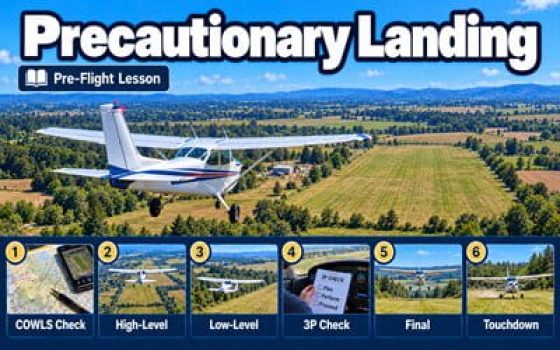
Learn how to plan and conduct a precautionary landing when an unfamiliar landing area, uncertain surface conditions, or developing flight circumstances make a normal landing unsuitable or unavailable.
The objective is to assess a potential landing site, recognize hazards, conduct appropriate inspections when conditions permit, and make a safe landing decision before the situation becomes critical.
Understand when a precautionary landing may be appropriate, and how it differs from a forced landing.
Learn to assess an unfamiliar landing area using the COWLS check and identify conditions that could make the site unsafe.
Study the high-level and low-level inspection sequence, final circuit, and situations in which an inspection should be shortened or omitted.
Deteriorating weather, approaching darkness, navigation difficulties, fuel concerns, mechanical problems, or uncertainty about a landing surface may require a pilot to reconsider the original flight plan.
A precautionary landing is a deliberate decision to land at a suitable location before conditions become more dangerous. When time, aircraft condition and available power permit, inspecting the proposed landing area can help identify hazards that are difficult to recognize from the air.
However, a developing emergency may leave insufficient time or aircraft performance for repeated inspections. The pilot must prioritize aircraft control, a suitable landing area, and the safest available course of action.
Before studying this procedure, review Airport Traffic Pattern (Circuit) and Normal Approach and Landing . The Soft Field Landing lesson is also relevant when a suitable landing area has an unpaved surface.
Precautionary Landing: Airspeed, Altitude, and Visual Judgment
Inspecting an unfamiliar landing area from the air requires a careful balance between observation and aircraft control. Flying slower may provide more time to examine the surface, while flying lower may reveal additional details. Both choices can reduce the pilot's safety margins.
Slower Is Not Always Safer
A slower airplane covers less ground during an inspection, giving the pilot more time to observe the landing area.
However, reducing airspeed also reduces the margin above the stall, particularly when turning or encountering turbulence.
Excessive speed creates a different problem: the pilot has less time to recognize and assess important surface details.
Maintain an appropriate airspeed and configuration for the aircraft, with a safe margin above the stall.
Lower Means Less Room for Error
From higher altitude, the pilot can see the overall layout of the proposed landing area, but small surface details may be difficult to identify.
Descending provides a closer view of the surface, but reduces clearance from terrain and obstacles.
It also leaves less height available to recover from an unexpected control or performance problem.
Never descend solely to obtain a better view when safe clearance cannot be maintained.
Why Groundspeed Can Be Misleading
During an inspection, the movement of the ground can create a misleading impression of the airplane's speed. Wind changes groundspeed even when indicated airspeed remains unchanged.
The airplane may appear to move slowly over the field because its groundspeed is reduced. This does not mean the airplane has additional margin above the stall.
The terrain passes beneath the airplane more quickly, even at the same indicated airspeed. This apparent speed must not be confused with actual airspeed.
The important distinction: The airspeed indicator remains the primary reference for the airplane's speed through the air. Ground movement helps the pilot judge the flight path, but not the margin above the stall.
Avoid Fixating on the Landing Area
Looking closely at a field can draw the pilot's attention away from the airplane. During an inspection, maintain a continuous scan between the proposed landing area, flight instruments, flight path, and surrounding terrain.
This becomes particularly important during turns and at lower altitude, where changes in bank, airspeed, or descent rate leave less room for recovery.
An inspection provides useful information only when it can be conducted safely. If maintaining an adequate view would require unsafe airspeed, altitude, bank angle, or obstacle clearance, do not continue that inspection.
Maintain safe airspeed, adequate altitude, and continuous aircraft control. Remember that wind affects groundspeed, not the airplane's indicated airspeed. Never allow attention to the landing area to compromise the flight path.
The COWLS Check: Selecting a Suitable Landing Area
The COWLS check provides a practical way to compare possible landing areas before committing to an unfamiliar site. Each letter represents a factor that can affect the suitability of the field.
Civilization
Consider whether roads, buildings or other accessible locations are nearby. Access may help occupants obtain assistance after landing.
However, a field near civilization is not necessarily safer. Avoid creating a hazard to people, vehicles or property on the ground.
Obstacles
Examine the proposed landing area and its approach and departure paths for trees, buildings, fences, poles, towers and other obstructions.
Power lines are particularly dangerous: the wires may be nearly invisible from the air. Look for supporting poles, especially along roads and field boundaries.
Wind
Determine the likely surface wind direction and strength. Useful clues may include windsocks, drifting smoke, dust, moving vegetation or rippling crops.
An approach into the wind is generally preferable because it reduces groundspeed at touchdown. However, wind direction must be considered together with obstacles and available landing distance.
Length
Estimate the usable landing distance, not simply the total length of the field. Allow for obstacles, unsuitable ground and the distance needed to stop safely.
Compare the available distance with the aircraft's landing performance, allowing for wind, slope, surface condition and an appropriate margin.
At 60 knots groundspeed, the airplane covers approximately 100 feet per second. A 15-second interval therefore represents roughly 1,500 feet of travel over the ground. This is only a rough estimation aid, not a substitute for landing performance data.
Surface
The surface should be sufficiently firm, smooth and level to support the aircraft. Look for signs of standing water, deep snow, recently cultivated soil or areas likely to be soft.
Also examine the field for rocks, ruts, furrows, holes, tall crops, uneven ground and changes in slope. Grass or soil that appears smooth from above may conceal hazards.
A long field may have an unsafe surface. A smooth field may have power lines across its approach. A favorable wind direction does not compensate for insufficient landing distance or serious obstacles.
Evaluate the five factors together. If a critical hazard makes the candidate area unsuitable, consider another option whenever circumstances permit.
C — Civilization and access; O — Obstacles; W — Wind; L — Usable landing length; S — Surface suitability.
No single favorable factor makes a landing area safe. The overall assessment must support the landing decision.
High-Level Inspection: Assessing the Landing Area from Above
The high-level inspection allows the pilot to assess the overall layout of a potential landing area and prepare the intended circuit. A traditional training reference is approximately 1,000 feet AGL, when conditions and applicable altitude requirements permit.
Establish Inspection Altitude
Set the appropriate airspeed and configuration according to the AFM/POH. Maintain a safe inspection altitude with adequate terrain and obstacle clearance.
Fly Alongside the Field
When practical, enter on the upwind side and fly a parallel pass beside the field. Keep the proposed landing area on the pilot's left to obtain a clear side view.
Examine the Overall Layout
Confirm the proposed landing direction and assess the field's general suitability. Identify the approach path, surrounding terrain, and a possible overshoot route.
Plan the Circuit
Select recognizable landmarks for the crosswind, downwind, base and final legs. Decide whether the field is suitable for further inspection before descending.
The inspection track and altitude shown are illustrative. The actual flight path depends on wind, terrain, obstacles, airspace and visibility.
Do not descend or fly closer to the field if doing so would compromise aircraft control or safe obstacle clearance. An inspection may need to be shortened or omitted when conditions require it.
Establish a safe altitude → fly alongside the field for a clear view → assess the overall layout → establish circuit references → decide whether further inspection is appropriate.
Low-Level Inspection and Final Circuit
The low-level inspection allows the pilot to examine details that were difficult to distinguish during the high-level inspection. If the field remains suitable, the pilot overshoots, climbs back to circuit altitude, and prepares for the final landing.
Low-Level Inspection
Configure the Aircraft
Establish the recommended inspection airspeed, power setting and flap configuration for the aircraft. Use carburetor heat when required by the applicable checklist and operating conditions.
Descend to Inspection Altitude
When conditions permit, descend toward the traditional training reference of approximately 500 feet AGL. Maintain a safe flight path with adequate obstacle clearance and an appropriate lateral offset from the field.
Examine Surface Details
Fly alongside the proposed landing area and examine details that were uncertain from higher altitude. Pay particular attention to surface irregularities, possible obstructions and the usable landing area.
Decide and Overshoot
Decide whether the field remains acceptable. Complete the planned inspection pass and overshoot. If the field is unsuitable, select another option whenever circumstances allow.

Final Circuit and Landing
Climb to Circuit Altitude
Following the overshoot, establish a safe climb and return to normal circuit altitude when circumstances permit. Rejoin the planned circuit while maintaining obstacle clearance.
Complete the 3P Check
On downwind, complete the traditional 3P check before the final approach.
Establish the Final Approach
Fly a stabilized approach using the appropriate airspeed and configuration. When suitable, plan the touchdown in the first third of the usable field, allowing sufficient distance to stop.
Touchdown and Rollout
Use a landing technique appropriate to the actual surface and aircraft. A soft-field technique may be suitable for a genuinely soft surface. Maintain directional control and avoid unnecessarily aggressive braking on uncertain ground.
A low inspection pass is not required in every precautionary landing. Reduced engine power, mechanical problems, icing, poor visibility, low cloud ceilings or insufficient time may make another inspection unsafe or impractical.
Do not descend merely to complete the training sequence. If aircraft performance or conditions are deteriorating, prioritize the safest achievable landing. If the final approach becomes unstable, go around when aircraft performance and conditions make it safe to do so.
Configure the aircraft → inspect at a safe altitude → decide on the field → overshoot and climb → complete the 3P check → establish a stabilized final → touch down within the usable landing area.

Common Precautionary Landing Errors and Go-Around Decisions
A suitable landing area does not guarantee a safe landing. During a precautionary landing procedure, the pilot must continue evaluating the aircraft, approach and remaining options. The following errors can turn a manageable situation into a hazardous one.
Becoming Committed to One Field
After selecting a field, a pilot may become reluctant to abandon it, even when new information reveals serious hazards.
Keep reassessing the site. Be prepared to reject it and consider an alternative while sufficient options remain.
Delaying the Landing Decision
Repeated inspections or excessive hesitation may consume valuable fuel, daylight or time, especially if aircraft conditions are worsening.
Set a clear decision point. Gather only the information needed to make the safest available choice.
Continuing an Unstable Final
Excessive airspeed, large heading corrections, an uncontrolled descent rate or poor alignment can make the final approach unsafe.
Recognize instability early. Discontinue the approach if a safe go-around can be completed.
Forcing the Touchdown Point
A pilot may steepen the descent excessively or make abrupt corrections to reach a preferred touchdown area.
Maintain a controlled, stabilized approach. Do not sacrifice aircraft control to reach a specific spot.
Landing Too Far Along the Field
Excess approach speed or a prolonged float can result in touchdown beyond the intended area, leaving insufficient distance to stop.
Monitor the touchdown area and remaining usable distance. Do not continue a long landing when a safe alternative remains available.
Assuming a Go-Around Is Guaranteed
A pilot may plan to overshoot without considering whether the engine, terrain and available climb performance will actually permit it.
Assess go-around capability before descending. Never assume that an aircraft with reduced power can safely climb away.
Go-Around Decision Guide
A go-around can be the safest response to a deteriorating approach, but only when the aircraft has sufficient performance and a usable flight path. The decision must account for the actual circumstances.
New information reveals a serious obstacle, inadequate usable area or another unacceptable hazard.
Discontinue the attempt and select a safer alternative if aircraft performance, time and conditions permit.
The airplane cannot maintain a controlled approach toward an acceptable touchdown area.
Initiate the appropriate go-around procedure when sufficient power, obstacle clearance and a safe climb path are available.
Engine problems, insufficient climb performance or surrounding obstacles may prevent a safe overshoot.
Avoid attempting a climb the aircraft cannot sustain. Maintain aircraft control and use the safest achievable landing path.
Unlike a routine landing at an established airport, a precautionary landing may take place with uncertain terrain, reduced engine performance or limited alternatives.
A go-around must never be treated as an automatic solution. If the aircraft cannot safely climb away, the pilot must manage the situation as an abnormal or emergency landing, maintaining control and following the applicable aircraft procedures.
Reassess the landing site, recognize an unstable approach early, protect the available landing distance, and never assume that a go-around is guaranteed. The best decision is the one that preserves aircraft control and the safest achievable landing option.
Precautionary Landing Review Questions
Test your knowledge of the COWLS check, field selection, high-level and low-level inspections, the 3P check, final approach, and go-around decisions.
Answer each question before opening the explanation. Think about the reason behind each decision rather than memorizing a sequence alone.
Part 1 — Landing Area Selection
Apply the COWLS check and assess the suitability of an unfamiliar field.
What does COWLS stand for, and what is its purpose?
C — Civilization: Nearby access and assistance, without creating danger to people on the ground.
O — Obstacles: Hazards within the field and along the approach or departure paths.
W — Wind: Direction and strength of the surface wind.
L — Length: Available usable landing distance.
S — Surface: Firmness, smoothness, slope and other surface conditions.
The check helps compare candidate landing areas, but no single favorable factor guarantees a safe landing.
A field looks long and smooth, but power lines cross its approach path. What should the pilot conclude?
The field may be unsuitable despite its apparent length and smooth surface. Approach obstacles can be a critical hazard.
Power lines are often difficult to distinguish from the air. Supporting poles may provide a more visible indication of their presence.
If a safe approach path cannot be established, consider another site while alternatives remain.
Why is landing into the wind generally preferable, and can other factors outweigh the wind direction?
A headwind generally reduces groundspeed at touchdown and may reduce the distance needed to land and stop.
However, wind is only one part of field suitability. Obstacles, terrain, slope and usable distance may make an into-wind approach unsafe.
The pilot must consider the overall landing situation rather than selecting a direction based on wind alone.
An aircraft travels along a field at 60 knots groundspeed for 15 seconds. Approximately how much ground distance does it cover?
At 60 knots groundspeed, an aircraft travels approximately 100 feet per second.
Over 15 seconds, the estimated distance is 1,500 feet.
This is a rough distance-estimation method. It requires a reasonable groundspeed estimate and does not determine whether the field is long enough to land. Actual landing performance must still be considered.
Part 2 — High-Level and Low-Level Inspections
Review the purpose, positioning and limitations of aerial inspections.
What is the main purpose of the high-level inspection, compared with the low-level inspection?
The high-level inspection helps the pilot assess the field's overall layout, establish circuit references and identify possible approach and overshoot paths.
The low-level inspection provides a closer view of surface details that may not have been visible from higher altitude.
The two inspections provide different kinds of information. Neither should be conducted when conditions make the maneuver unsafe.
Why does the aircraft normally fly alongside the field rather than directly over its center?
An offset track provides a clearer side view of the field, its surface and boundaries.
When the airplane flies directly overhead, parts of the aircraft may obstruct the view of the ground below.
Keeping the field on the pilot's left is a common training arrangement when practical. The actual offset must preserve safe obstacle clearance.
What are the traditional training altitude references for high-level and low-level inspections?
The training sequence presented in this lesson uses approximately 1,000 feet AGL for the high-level inspection and 500 feet AGL for the low-level inspection.
AGL means above ground level.
Actual inspection altitudes depend on terrain, obstacles, visibility, airspace, applicable altitude requirements and aircraft performance. Do not descend to a training reference if doing so would be unsafe or unlawful.
In what circumstances might the pilot omit the low-level inspection?
A low-level inspection may be inappropriate when conditions leave insufficient time or safety margin.
Examples include engine problems, deteriorating weather, poor visibility, low cloud ceilings, or inadequate obstacle clearance.
The priority is the safest achievable landing, not completing every step of a training exercise.
Part 3 — Final Circuit and Landing Decisions
Apply the final preparation, touchdown and go-around decision principles.
After completing a satisfactory low-level inspection, what is the normal next sequence?
In the traditional training procedure, the pilot overshoots the field, climbs toward circuit altitude, rejoins the planned circuit and prepares for the final approach.
This sequence is appropriate only when aircraft performance, obstacles and conditions permit a safe climb.
The pilot should not assume that a go-around is possible when the engine or other aircraft systems are compromised.
What are the three elements of the 3P check performed before the final landing?
P1 — Pan-Pan: Make an urgency call when the circumstances warrant one. A distress situation calls for Mayday instead.
P2 — Passengers: Brief passengers and prepare them for the landing.
P3 — Pre-Landing: Complete the applicable pre-landing checklist for the aircraft.
The radio call must reflect the seriousness of the situation. Do not allow communication to interfere with aircraft control.
Why is a long touchdown particularly hazardous during a precautionary field landing?
Touching down too far along the field reduces the remaining distance available to stop.
The lesson recommends aiming within the first third of the usable landing area when appropriate, while maintaining a controlled approach and adequate clearance from obstacles.
The intended touchdown point must not be forced through excessive speed, abrupt maneuvers or an unstable descent.
The final approach becomes unstable, but engine performance is uncertain. Is an immediate go-around always the safest choice?
No. A go-around requires sufficient engine power, aircraft performance and a safe climb path.
When these conditions exist, discontinuing an unstable approach may be the safest decision.
However, attempting to climb with inadequate performance can create a more dangerous situation. The pilot must evaluate the safest achievable flight path and maintain aircraft control.
During a precautionary or emergency landing, the decision must account for actual aircraft capability and surrounding obstacles.
A sound precautionary landing decision combines careful site assessment, safe aircraft handling, appropriate inspection, and timely judgment. The COWLS check helps assess a landing area, while the inspection and final circuit procedures support a controlled landing when circumstances permit.
The overriding principle is to maintain aircraft control and preserve the safest achievable landing option.