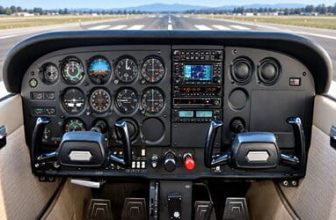
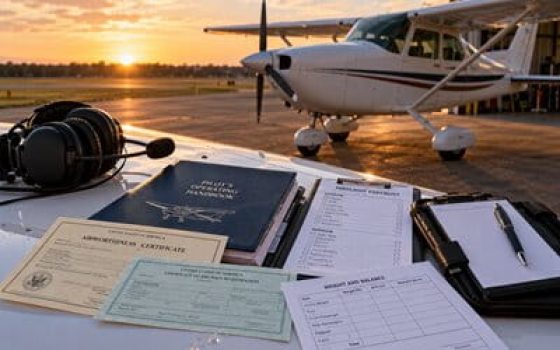
This pre-flight lesson introduces two important parts of early flight training. First, you will become familiar with the sensations of flight and the aircraft environment. You will then review the aircraft documents required before flight, including the Airworthiness Certificate and other documents that must be carried on board.
Familiarization Flight
The familiarization flight gives a new student pilot an opportunity to experience the aircraft, observe the local flying area and become comfortable with the basic sensations of flight.
Lesson Purpose
- Become familiar with the physical sensations of flight.
- Become familiar with the aircraft and begin understanding how to determine whether it is ready for flight.
Instructor Notes
- Point out recognizable local landmarks.
- Allow the student to take the controls when appropriate.
- Avoid turbulence and steep bank angles during the familiarization flight.
Why Is This Important?
A first flight should help the student become comfortable in the aircraft and connect ground instruction with the real experience of flying. Early familiarization also provides context for the procedures and preparation that will be introduced throughout flight training.
Required Aircraft Documents
Before departure, a pilot must know which aircraft documents are required on board and understand the purpose of each one. For U.S. flight training, one of the most important is the Airworthiness Certificate, which confirms that the aircraft meets the applicable airworthiness requirements.
The ARROW Check
In the United States, student pilots commonly use the acronym ARROW to remember the aircraft documents and information that should be available before flight.
Airworthiness Certificate
RequiredThe aircraft must carry an appropriate and current Airworthiness Certificate. The certificate must be displayed at the cabin or cockpit entrance so that it is legible to passengers or crew.
Registration Certificate
RequiredThe aircraft must carry an effective registration certificate or another registration document permitted by the applicable FAA regulations.
Radio Station License
If RequiredA separate FCC aircraft station license is generally not required for normal domestic U.S. operations. It may be required for international operations or communications.
Operating Limitations
RequiredOperating limitations may include the FAA-approved Airplane Flight Manual or Pilot's Operating Handbook, applicable supplements, placards and instrument markings.
Weight and Balance Documents
RequiredCurrent aircraft-specific weight and balance information must be available so the pilot can determine whether the aircraft is properly loaded for the planned flight.
United States vs. Canada
Radio station licensing rules are similar for many domestic flights in the two countries, but they are not identical and international operations require additional attention.
Domestic U.S. Operations
An individual FCC aircraft station license is generally not required when the aircraft does not make international flights or communications and no other rule or international agreement requires the radio to be licensed.
Domestic Canadian Operations
A radio station licence is generally not required when the aircraft operates only in Canadian airspace and its radio equipment operates only on frequencies allocated to aeronautical communications or radionavigation. A Radio Operator Certificate is still required to operate the aeronautical radio.
Canadian Aircraft Have Some Different Requirements
Canadian regulations use different terminology and include several requirements that do not form part of the U.S. ARROW mnemonic.
- A valid Flight Authority, such as a Certificate of Airworthiness, is normally carried on board.
- The Certificate of Registration must be carried on board.
- The Aircraft Flight Manual must be available to the flight crew when required for that aircraft.
- The aircraft Journey Log is normally carried on board, although it may remain behind when the flight is planned to return to the departure point without landing and shutting down elsewhere.
- If a radio licence has been issued for the aircraft, the licence or a copy must be carried on board.
Pilot Documents Are Not Aircraft Documents
Pilot certificates, identification and medical qualifications should be checked separately. They should not be mixed into the ARROW list of aircraft documents.
Additional Preflight Checks
Aircraft documents are only one part of preparing for a flight. Before departure, the pilot should also verify that the aircraft can be safely loaded and that its expected performance is suitable for the planned conditions.
Weight and Balance
- Determine the takeoff and landing weights.
- Confirm that the aircraft remains within its approved center-of-gravity limits.
- Consider how the aircraft's loading and center of gravity may affect its handling and performance.
Aircraft Performance
- Review the expected takeoff distance.
- Review the expected landing distance.
- Check relevant climb and cruise performance, including expected true airspeed when appropriate.
Flight Plans and Flight Itineraries
Flight plan requirements differ between the United States and Canada. Student pilots should know when a flight plan or flight itinerary is required, how it is activated and how it is closed after the flight.
VFR Flight Plans
Within the continental United States, a VFR flight plan is not normally required, but the FAA strongly recommends filing one because an activated VFR flight plan provides search-and-rescue protection.
- Know when a VFR flight plan is required.
- Know how to file and activate the flight plan.
- Provide the required flight information accurately.
- Remember that the pilot is responsible for closing an active VFR flight plan.
Flight Plan or Flight Itinerary
In Canada, a VFR flight plan or VFR flight itinerary is normally required when the flight extends beyond 25 nautical miles from the departure aerodrome.
- Know whether a flight plan or flight itinerary is required.
- Know where and how it is filed.
- Keep the information current if the flight changes.
- Ensure that the required arrival report is made after the flight.
Opening and Closing Matter
Filing a VFR flight plan is not the end of the process. In the United States, the pilot is responsible for activation and closure. In Canada, the pilot must ensure that the required arrival report is filed within the applicable time limits.
Chart Supplement and Canada Flight Supplement
Before flying to an unfamiliar airport, know where to find current airport information and how to confirm that the publication you are using is up to date.
Chart Supplement U.S.
The FAA Chart Supplement provides detailed information that may not be practical to display directly on an aeronautical chart.
- Airport and runway information.
- Communications and navigation facilities.
- Airport diagrams and operational information.
- Weather information sources and special notices.
Canada Flight Supplement
The Canada Flight Supplement provides detailed aerodrome and operational information for Canadian flight planning and operations.
- Aerodrome and heliport information.
- Flight-planning information.
- Navigation and communication facilities.
- Operational and emergency information.
Check the effective date: both the FAA Chart Supplement and the Canada Flight Supplement are published on a 56-day cycle. Always confirm that your aeronautical information is current and check applicable NOTAMs before flight.
Review Questions
Before moving on, make sure you can answer these questions without referring back to the lesson.
What important information can you find in the FAA Chart Supplement U.S. or the Canada Flight Supplement?
Why must current weight and balance information be available before takeoff?
What sources can a pilot use to obtain current weather information before a flight?
When might a pilot need a flight plan or flight itinerary?
Name at least three documents or items that must be available on board a U.S.-registered aircraft.
Related Pre-Flight Lessons
These StudyFlight lessons continue several of the topics introduced during flight preparation.
VFR Navigation
Learn how to prepare for and conduct a safe cross-country flight using the appropriate charts, planning information and navigation techniques.
Continue to Navigation PerformanceRange and Endurance
Review how aircraft performance, fuel consumption and operating conditions affect range and endurance.
Review Range & EnduranceASA 2027 FAR/AIM Handbook
A useful printed reference for student pilots who want quick access to current Federal Aviation Regulations and the Aeronautical Information Manual while studying for flight training, knowledge tests and checkrides.
View the FAR/AIM at PilotMall →Affiliate link — StudyFlight may earn a commission from qualifying purchases at no additional cost to you.