Crosswind Landing: Complete Pre-Flight Lesson

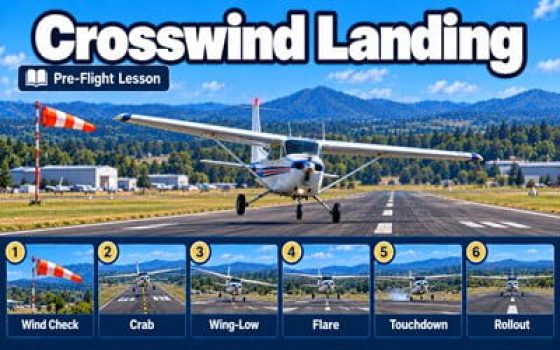
Crosswind landing training illustration showing a Cessna airplane, windsock, crab approach, wing-low correction, flare, touchdown and rollout.
Pre-Flight Lesson Approaches & Landings
Lesson Objective

Learn how to perform a crosswind landing while maintaining a controlled flight path, preventing unwanted lateral drift, and aligning the airplane with the runway before touchdown.

This lesson develops the knowledge and skills needed to evaluate crosswind conditions, use the crab and wing-low landing techniques, and maintain directional control from final approach through touchdown and rollout.

You will also learn to calculate headwind and crosswind components, interpret aircraft crosswind guidance, recognize common landing errors, and determine when a go-around is necessary.

01 / Understand Crosswind Effects

Understand how wind direction and speed influence the airplane's ground track, runway alignment, and landing conditions.

02 / Practice Landing Techniques

Learn how to use crab and wing-low corrections during final approach, transition to touchdown, and maintain control during the landing roll.

03 / Decide Crosswind Safety

Evaluate crosswind components, wind gusts, aircraft guidance, and personal limitations before deciding whether to continue the landing.

Why Study Crosswind Landings?

Wind rarely blows perfectly along the runway centerline. During many approaches, at least part of the wind acts across the runway, requiring the pilot to correct for drift while maintaining a stable descent toward the touchdown area.

The challenge becomes particularly important near touchdown. The airplane must contact the runway without excessive sideways movement or misalignment that could place unnecessary side loads on the landing gear. As the airplane decelerates, changing control effectiveness requires continued attention to runway alignment and directional control.

Crosswind landing proficiency builds directly on the Normal Approach and Landing Pre-Flight Lesson . The basic approach, roundout, flare, and landing sequence remain applicable, but additional wind corrections are necessary to complete the maneuver safely.

Always follow the applicable AFM/POH, approved procedures, aircraft limitations, and instructor guidance. Select a runway and operating conditions appropriate for both the airplane and the pilot's proficiency.

Crosswind Landing Fundamentals

What Is a Crosswind Landing?

During a crosswind landing, the wind approaches the runway from an angle rather than blowing directly along its centerline. The resulting sideways wind component affects the airplane's movement over the ground.

To understand why crosswind corrections are necessary, a pilot must distinguish between the direction the airplane is pointing and the direction it is actually traveling. These two directions are not always the same.

Aircraft Heading vs. Ground Track

Aircraft Heading

Where the Nose Points

Heading is the direction in which the airplane's longitudinal axis points. It describes the orientation of the airplane, not necessarily its path over the ground.

In a crosswind, the nose may need to point slightly into the wind to compensate for drift. The airplane can therefore be flying directly toward the runway while its nose is not aligned with the centerline.

Ground Track

Where the Airplane Travels

Ground track is the actual path the airplane follows over the surface.

It results from the combination of the airplane's movement through the air and the movement of the surrounding air mass. Without adequate correction, a crosswind changes the ground track and carries the airplane away from the runway centerline.

Understanding Crosswind Drift Aircraft heading and ground track with wind from the left A runway is shown vertically. Wind blows from left to right. The aircraft heading points slightly left into the wind, while the corrected ground track follows the runway centerline. Wind from left Aircraft heading Ground track Runway centerline
With wind from the left, the airplane may need to point into the wind while maintaining a ground track along the runway centerline. Simplified illustration, not to scale.
Example: Approaching with Wind from the Left

Imagine an airplane approaching a runway while the wind blows from left to right. If the pilot points the nose directly along the runway without correcting for the wind, the airplane's ground track will drift toward the right.

By pointing the airplane slightly into the wind, the pilot can establish a ground track that follows the runway centerline. The exact correction depends on the wind and the airplane's airspeed.

This explains why an airplane on a properly corrected crosswind approach may appear to be pointing away from the runway direction, even though it is traveling straight toward the landing area.

What Must Change Before Touchdown?

During the approach, an airplane can maintain a straight ground track while its nose points into the wind. At touchdown, however, the airplane must be aligned with the runway and have no significant sideways movement relative to the surface.

Two Conditions for a Controlled Touchdown

1. Correct Runway Alignment

The airplane's longitudinal axis should be aligned with the runway direction when the wheels contact the surface. Touching down while still crabbed can create undesirable side loads on the landing gear.

2. No Significant Sideways Drift

The airplane should not be moving sideways across the runway at touchdown. Correct alignment alone is insufficient if lateral drift remains.

Runway Alignment and Drift Correction Are Two Different Requirements

An airplane can be aligned with the runway while drifting sideways, or it can follow the centerline while its nose points into the wind.

Neither condition alone guarantees a properly controlled crosswind touchdown. The pilot must manage both alignment and lateral movement before the wheels contact the runway.

The Essential Crosswind Landing Concept

Heading describes where the airplane points. Ground track describes where it travels. During a crosswind approach, these directions may differ. Before touchdown, the pilot must achieve proper runway alignment while eliminating significant sideways drift.

Crosswind Assessment

Crosswind Component Calculations and Limits

Before landing in a crosswind, determine how much of the reported wind is blowing across the runway. A wind component chart makes this easy: you only need the runway direction, wind direction, and wind speed.

Crosswind Component

The portion of the wind blowing across the runway, from the left or the right.

Headwind Component

The portion of the wind blowing toward the airplane along the runway direction.

Check the wind reference: Runway directions are magnetic. U.S. ATIS and radio weather reports give magnetic wind directions, while METAR wind directions use true north. Always compare directions using the same reference.

Worked Example: Runway 27, Wind 300° at 18G26 KT

Wind from the Right
Runway Direction 270°
Wind From 300°
Wind Speed 18G26 kt

The runway points toward 270°. The wind comes from 300°, which is 30° to the right of the runway heading. Use the 30° wind angle and the 18-knot and 26-knot wind speed curves.

Animated Wind Component Chart
Crosswind Component Chart Runway 27, wind from 300 degrees at 18 knots gusting to 26 knots. Permanent blue and orange wind speed curves show the two reported speeds. A 30-degree wind angle intersects them at 9 and 13 knots of crosswind and approximately 16 and 23 knots of headwind. CROSSWIND COMPONENT CHART Runway 27 | Wind from 300° | 18 kt gusting to 26 kt 18 kt WIND 26 kt GUST 0 5 10 15 20 25 30 0 5 10 15 20 25 30 0° 15° 45° 60° 75° 90° CROSSWIND COMPONENT (kt) HEADWIND COMPONENT (kt) 30° WIND SPEED CURVES 18 kt 26 kt SUSTAINED WIND 9 kt crosswind 16 kt headwind GUST 13 kt crosswind 23 kt headwind
The blue and orange wind speed curves remain visible throughout the example. The animation shows the 30° wind angle and how to read the crosswind and headwind components.

How to Read the Diagram

1. Find the Wind Angle

Start at the 30° angle. Follow the green line toward the wind speed curves.

2. Find the Wind Speed

The 30° line crosses the blue 18-knot curve and the orange 26-knot curve.

3. Read the Crosswind

Follow each dashed line down to the bottom scale. Read 9 kt and 13 kt.

4. Read the Headwind

Follow the dashed lines left to the vertical scale. Read approximately 16 kt and 23 kt.

Crosswind Limits and Landing Decisions

Aircraft Guidance

Check the airplane's AFM/POH. A maximum demonstrated crosswind is not automatically an operating limitation. Identify the limits and procedures that apply to the aircraft.

Pilot and Runway Conditions

Consider your proficiency, flight school limits, runway width and surface, gusts, turbulence, and available alternate runways.

Evaluate the Gusts, Not Just the Sustained Wind

In this example, the crosswind component increases from 9 knots to 13 knots during the reported gusts, assuming the wind direction remains constant. Actual conditions near the runway may change further.

Crosswind Calculation — Remember

Identify the runway direction, wind direction, and speed. Determine the wind angle, follow the appropriate wind speed curve, and read the crosswind and headwind components before evaluating aircraft and personal limits.

Crosswind Landing Techniques

Crosswind Landing Techniques: Crab vs. Wing-Low

Pilots use two principal techniques to compensate for crosswind during the approach and landing: the crab method and the wing-low method, also called a sideslip.

Both methods can keep the airplane tracking toward the runway. The important difference is how the pilot uses the flight controls to counteract the wind.

1

The Crab Method

In the crab method, the pilot points the nose slightly into the wind while keeping the wings approximately level.

The airplane's heading is adjusted so that its ground track remains aligned with the runway. A stronger crosswind generally requires a greater crab angle.

This technique is useful during final approach because the airplane can maintain a coordinated flight attitude while compensating for wind drift.

Crosswind landing crab method illustration showing the aircraft angled into the wind during approach
Crab method: the airplane points into the wind to maintain its desired ground track.
Wings Approximately Level

The airplane is flown in a coordinated attitude with its heading adjusted into the wind.

Heading Adjusted for Drift

The pilot adjusts the crab angle as needed to keep the approach aligned with the runway.

Before touchdown: in a typical light training airplane, the pilot transitions out of the crab and establishes the appropriate wing-low correction so the wheels contact the runway without significant sideways movement. Follow the aircraft-specific landing procedure.

2

The Wing-Low (Sideslip) Method

In the wing-low method, the pilot lowers the wing on the side from which the wind is blowing.

Aileron into the wind produces enough bank to prevent the airplane from drifting sideways.

At the same time, opposite rudder is used as needed to keep the airplane's nose aligned with the runway.

Unlike the crab method, the airplane can maintain runway alignment while holding the upwind wing slightly lower.

Crosswind landing wing-low sideslip technique illustration
Wing-low method: aileron into the wind controls drift while rudder maintains alignment.
Aileron Controls Drift

Lower the upwind wing enough to prevent sideways movement across the runway.

Rudder Controls Alignment

Use rudder pressure as needed to keep the airplane's longitudinal axis aligned with the runway.

These corrections work together and must be adjusted continuously as wind conditions change. With proper wing-low technique, the upwind main wheel normally touches first, followed by the downwind main wheel.

Control Example: Wind from the Right

Imagine an airplane approaching Runway 27 with wind from 300°, as in our previous example. The wind is coming from the airplane's right side.

Aileron Right Aileron Into the Wind

Apply enough right aileron to lower the right wing and prevent the airplane from drifting left.

Rudder Left Rudder as Needed

Apply sufficient left rudder to keep the nose aligned with the runway, rather than allowing the airplane to turn right.

With an appropriate correction, the right main wheel, which is on the upwind side, normally touches first. The controls are adjusted as needed to maintain runway alignment and control.

Crab vs. Wing-Low: What Is the Difference?

Control Crab Method Wing-Low Method
Airplane Heading Nose points into the wind. Nose aligned with the runway.
Wing Position Wings approximately level. Upwind wing slightly lowered.
Drift Correction Corrected by adjusting heading into the wind. Corrected by banking into the wind.
Typical Use Final approach, before transitioning to touchdown. Final approach, flare and touchdown.

Combining Crab and Wing-Low

Many light-airplane crosswind landings combine both methods. The crab helps maintain the desired ground track during the approach, while the wing-low correction establishes the alignment needed for touchdown.

Stage 1 Crab on Final Approach

Point the nose into the wind enough to maintain the intended runway track.

Stage 2 Transition to Wing-Low

Before touchdown, smoothly use rudder to align the nose and aileron into the wind to prevent drift.

Stage 3 Maintain the Correction

Hold the required crosswind correction through the flare and touchdown, adjusting as necessary.

Do Not Force a Crosswind Landing

A crosswind correction must keep the airplane under control without excessive bank, significant sideways drift, or improper runway alignment.

Aircraft geometry, control authority, gusts and runway conditions may restrict the correction that can be safely maintained. If the airplane cannot be kept on the desired path with appropriate alignment, initiate a timely go-around. Always follow the applicable AFM/POH and instructor guidance.

Remember: Crab vs. Wing-Low

Crab: point the nose into the wind to maintain the desired ground track.

Wing-low: lower the upwind wing to control drift and use rudder to maintain runway alignment.

Before touchdown, use the aircraft-appropriate technique to achieve both proper alignment and controlled lateral movement.

Landing Procedure

Crosswind Landing: Step-by-Step Procedure

The following procedure combines the crab and wing-low techniques described in the previous section. The objective is to maintain a stable approach, touch down without significant sideways drift, and retain directional control throughout the landing roll.

1

Prepare for Landing

Check the current wind, runway conditions and crosswind component. Select the appropriate approach speed and flap setting according to the AFM/POH. Account for reported gusts.

2

Establish a Stable Final Approach

Maintain the proper airspeed, descent path and runway centerline ground track. Make smooth corrections for changes in the wind.

3

Maintain the Crab

Point the nose into the wind as needed to remain on the runway centerline. Keep the wings approximately level during the crabbed portion of the approach.

4

Transition to Wing-Low

Before touchdown, use rudder to align the nose with the runway. Apply aileron into the wind to prevent sideways drift. Adjust both controls as needed.

5

Perform the Roundout and Flare

Gradually reduce the descent rate while maintaining runway alignment and the necessary wing-low correction. Avoid excessive bank or abrupt control movements.

6

Touch Down on the Upwind Main Wheel

In a typical tricycle-gear training airplane, the upwind main wheel normally contacts the runway first. Allow the downwind main wheel to settle while maintaining crosswind correction.

7

Lower the Nosewheel

As the airplane slows, lower the nosewheel in a controlled manner according to the aircraft's landing procedure. Maintain runway alignment and appropriate aileron input.

8

Maintain Control During Rollout

Continue holding aileron into the wind, increasing deflection as needed while the airplane slows. Maintain directional control and apply braking as appropriate. Continue the correction into taxi.

Important: Do Not Force the Touchdown

If the approach becomes unstable, the airplane cannot be aligned with the runway, or sideways drift cannot be controlled, initiate a timely go-around. Do not attempt to salvage an unsafe landing.

Crosswind Landing — Remember

Stable approach → crab into the wind → transition to wing-low → align the nose → control drift → upwind main wheel first → maintain wind correction through rollout.

Common Errors and Safety

Common Crosswind Landing Errors and Go-Around Decisions

Crosswind landing errors often become most noticeable during the last few seconds of the approach. Small changes in wind, airspeed or control inputs can produce unwanted drift, runway misalignment or an unstable touchdown.

Recognizing these errors early is essential. The pilot must know when an adjustment is appropriate and when the safest decision is to discontinue the landing.

Eight Common Crosswind Landing Errors

1

Touching Down While Still Crabbed

Runway Alignment

The airplane contacts the runway while its longitudinal axis remains angled away from the runway direction.

This can produce substantial side loads on the landing gear and make directional control more difficult.

Correction

Establish runway alignment before touchdown using the aircraft-appropriate crosswind technique. Go around if proper alignment cannot be achieved safely.

2

Touching Down with Sideways Drift

Lateral Movement

The airplane's nose may be aligned with the runway, but the aircraft continues moving sideways across the surface.

Touching down with lateral movement can impose side loads on the tires and landing gear.

Correction

Maintain sufficient aileron into the wind to control drift. Do not attempt touchdown if significant sideways movement remains.

3

Using Rudder Alone to Fight Drift

Incorrect Control Use

During a wing-low approach, the pilot tries to stop sideways drift primarily by moving the rudder.

This changes the airplane's heading without necessarily correcting its lateral movement over the runway.

Correction

In a wing-low correction, use aileron to control drift and rudder to maintain runway alignment. Coordinate both inputs as conditions change.

4

Excessive Bank Near the Runway

Aircraft Clearance

The pilot increases bank excessively while trying to counteract a strong crosswind near touchdown.

Excessive bank can reduce wingtip or other aircraft clearance above the runway.

Correction

Use only the bank necessary to control drift, within the aircraft's safe operating geometry. If acceptable control requires excessive bank, go around.

5

Overcontrolling During Gusts

Control Coordination

Sudden, exaggerated aileron or rudder movements cause repeated changes in bank, heading or runway alignment.

Rather than correcting the approach, these movements may increase instability close to the ground.

Correction

Make smooth, timely corrections appropriate to the changing conditions. If the airplane begins oscillating or control cannot be stabilized, discontinue the landing.

6

Excessive Airspeed and Floating

Approach Energy

The pilot carries unnecessary extra airspeed into the flare, sometimes from an excessive gust correction.

The airplane floats farther down the runway, increasing landing distance and extending exposure to changing wind conditions.

Correction

Follow the AFM/POH and applicable guidance for approach airspeed and gust adjustments. Go around if the airplane floats beyond the acceptable touchdown area.

7

Releasing Aileron After Touchdown

Landing Roll

The pilot relaxes the crosswind correction immediately after the wheels contact the runway.

The crosswind may lift the upwind wing or make it more difficult to maintain control while the airplane slows.

Correction

Maintain aileron into the wind throughout the landing roll. As speed decreases, progressively increase the windward aileron deflection as appropriate.

8

Trying to Salvage an Unstable Approach

Pilot Decision-Making

The airplane is no longer on a satisfactory approach, but the pilot continues making increasingly large corrections to force a touchdown.

This may lead to excessive drift, a hard or misaligned landing, or insufficient runway remaining.

Correction

Recognize an approach that no longer meets stabilization criteria. Initiate a timely go-around instead of forcing the landing.

When Should You Go Around?

A go-around is appropriate when the airplane cannot be safely positioned, aligned and controlled for landing. The decision should be made early enough to execute the maneuver safely.

Unstable Approach

Airspeed or Descent Path Is Unacceptable

The approach no longer meets the applicable stabilization criteria, and a safe landing cannot be assured.

Excessive Drift

Runway Track Cannot Be Maintained

The airplane is moving away from the intended landing path despite appropriate corrections.

Improper Alignment

The Airplane Cannot Be Aligned for Touchdown

The nose cannot be safely aligned with the runway while controlling sideways movement.

Unsafe Landing Conditions

Control or Clearance Is Inadequate

Gusts, excessive bank, a balloon or bounce, or other control problems make a safe landing doubtful.

A Go-Around Is a Normal Safety Decision

Do not wait until the airplane is almost touching down to decide that the approach is unacceptable. An early go-around generally provides more time, altitude and margin for correction than a late decision.

Use the aircraft's published procedure and the stabilization criteria established during training.

Executing a Crosswind Go-Around

The go-around procedure follows the aircraft's normal published sequence, with continued attention to wind drift and directional control.

1

Apply Go-Around Power

Promptly apply the specified go-around power and establish the appropriate pitch attitude for the airplane.

2

Maintain Aircraft Control

Maintain coordinated directional control and use the necessary wind correction to keep the airplane on a safe departure path.

3

Configure for the Climb

Adjust flaps and other configuration items in the sequence specified by the AFM/POH. Avoid configuration changes that could compromise climb performance.

4

Establish a Safe Climb

Confirm the appropriate climb performance, maintain terrain and obstacle clearance, and communicate with ATC when workload permits.

What If the Wheels Have Already Touched Down?

A decision after touchdown requires particular care. The airplane's speed, position, remaining runway and controllability affect the available options.

Aircraft Under Control Maintain Directional Control

If the airplane is safely rolling on the runway, maintain control and use the applicable landing and braking procedures.

Bounce or Unsafe Touchdown Use the Appropriate Recovery

A bounced landing may require a balked landing or go-around. Follow the aircraft's approved procedures and training guidance rather than attempting to force the airplane back onto the runway.

Do not assume that adding power after touchdown is always the safest choice. The appropriate response depends on the aircraft and the circumstances.

Crosswind Landing Safety — Remember

Recognize unwanted drift, improper runway alignment, excessive bank, control oscillations and an unstable approach. Maintain the necessary wind correction through touchdown and rollout.

If safe alignment, flight path or control cannot be maintained, make a timely go-around using the aircraft's published procedure.

Knowledge Review

Crosswind Landing Review Questions

Test your knowledge of crosswind components, crab and wing-low techniques, touchdown control, landing rollout, and go-around decisions.

How to Use These Review Questions

Answer each question before opening the explanation. Use the situations to check whether you understand both the technique and the reason for applying it.

Part 1 — Crosswind Fundamentals

Review wind direction, runway alignment, crosswind components and aircraft guidance.

What is the difference between aircraft heading and ground track during a crosswind approach?
Answer & Explanation

Heading is the direction the airplane's nose points. Ground track is its actual path over the ground.

During a crosswind approach, the airplane may point into the wind while following a ground track aligned with the runway centerline.

On Runway 27, with wind from 300° at 18 knots gusting to 26, which side is the crosswind from and how strong is it?
Answer & Explanation

The wind is coming from the right at an angle of 30° to the runway.

The crosswind component is approximately 9 knots at the sustained wind speed, increasing to 13 knots at the reported gust speed if the direction remains unchanged.

Why must runway and wind directions use the same north reference when calculating crosswind?
Answer & Explanation

Because runway headings are magnetic, while wind directions may be reported relative to true or magnetic north.

In the United States, METAR wind directions are referenced to true north, while ATIS and radio weather broadcasts use magnetic directions. Comparing unlike references can produce an incorrect wind angle.

Is the maximum demonstrated crosswind component always an aircraft operating limitation?
Answer & Explanation

No. A maximum demonstrated crosswind is a value established during aircraft testing. It is not automatically an operating limitation.

The pilot must consult the approved AFM/POH for actual limitations and also consider personal proficiency, operator restrictions and runway conditions.

Part 2 — Crab and Wing-Low Techniques

Apply the correct flight controls during final approach, flare and touchdown.

How does the crab method correct for wind drift during final approach?
Answer & Explanation

The pilot points the nose into the wind enough to maintain the desired ground track.

The wings remain approximately level, and the airplane's heading differs from the runway direction while the ground track remains aligned with the runway.

With wind from the right, which aileron and rudder corrections are used in the wing-low method?
Answer & Explanation

Apply right aileron as needed to lower the upwind wing and control sideways drift.

Use left rudder as needed to keep the airplane's nose aligned with the runway.

Adjust both controls according to the wind and aircraft response.

What two conditions must be achieved for a controlled crosswind touchdown?
Answer & Explanation

The airplane must be aligned with the runway and have no significant sideways drift at touchdown.

Proper alignment without drift correction can still produce a sideways landing. Correct ground track alone is insufficient if the airplane remains improperly aligned.

During a wing-low landing with wind from the right, which main wheel normally touches first?
Answer & Explanation

The right main wheel, because it is the upwind wheel.

In a typical tricycle-gear training airplane, the upwind main wheel normally touches first, followed by the downwind main wheel as the airplane settles.

The pilot continues the appropriate crosswind correction throughout touchdown.

Part 3 — Landing Control and Safety

Identify landing errors, maintain control after touchdown, and make sound go-around decisions.

Why should aileron be held into the wind during the landing rollout?
Answer & Explanation

Aileron into the wind helps counteract the crosswind's tendency to lift the upwind wing.

As the airplane slows, aerodynamic control effectiveness decreases. The pilot generally increases aileron deflection into the wind as appropriate while maintaining directional control.

Why can excessive approach speed be especially undesirable during a crosswind landing?
Answer & Explanation

Excessive airspeed can cause the airplane to float farther down the runway, increasing landing distance.

It also prolongs the time spent close to the runway while maintaining crosswind correction. Use the appropriate approach speed and gust adjustment prescribed for the aircraft.

What crosswind landing conditions should prompt a go-around?
Answer & Explanation

A go-around is appropriate when the airplane cannot maintain a stable approach, runway alignment or adequate drift correction.

Excessive bank, unsafe gust responses, a deteriorating flight path or an unacceptable touchdown situation are additional reasons to discontinue the landing.

Safety Decision

Do not force a landing when the airplane cannot be controlled within safe limits.

During a crosswind go-around, what must the pilot do in addition to following the normal go-around procedure?
Answer & Explanation

The pilot must continue correcting for wind drift and maintain directional control while transitioning from the landing attitude to a safe climb.

Apply the prescribed power, establish the appropriate pitch attitude, adjust configuration according to the AFM/POH, and maintain the required climb path and obstacle clearance.

Remember

A go-around does not eliminate the crosswind. Wind correction remains necessary throughout the maneuver.

Lesson Complete Crosswind Landing — Key Takeaway

A controlled crosswind landing requires an appropriate ground track, proper runway alignment and minimal sideways movement at touchdown. Continue the necessary wind correction throughout the rollout, and go around whenever safe landing conditions cannot be maintained.

error:
Study flight
Logo