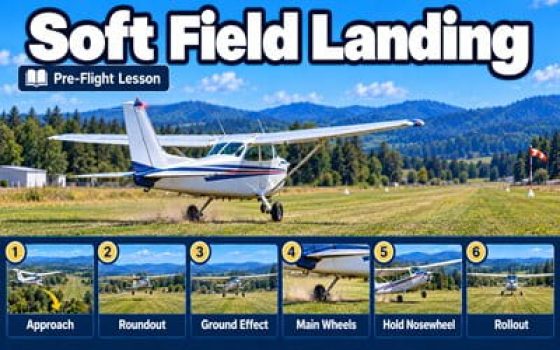
Learn how to perform a soft field landing on a soft or rough runway while minimizing stress on the landing gear and maintaining control throughout the touchdown and landing roll.
The primary objective is to transfer the airplane's weight gradually from the wings to the wheels, touch down gently on the main landing gear, and keep the nosewheel off the surface as long as practical.
Understand how ground effect, airspeed, power and pitch attitude help reduce the load carried by the landing gear.
Learn the approach, roundout, touchdown and landing-roll techniques used with and without obstacles near the runway.
Recognize unstable approaches, unsuitable runway conditions and situations that require a timely go-around.
Grass, sand, mud, snow and rough surfaces can place greater stress on an airplane's landing gear than a firm paved runway. If the nosewheel contacts a soft surface too heavily, it may dig in and cause abrupt deceleration or loss of control.
Unlike a short field landing, where stopping distance is a major consideration, soft field technique emphasizes a gentle touchdown, a controlled transfer of weight, and avoiding unnecessary braking. On very soft surfaces, maintaining forward movement may also be important.
Before studying the soft field landing procedure, review the Normal Approach and Landing lesson to understand the basic approach, roundout, flare and touchdown sequence.
What Is a Soft Field Landing?
The important difference between a normal landing and a soft field landing becomes particularly noticeable when the wheels contact the surface. On firm pavement, the wheels normally roll with relatively little resistance. On a soft or uneven runway, that resistance can be much greater, changing how the airplane behaves during touchdown and deceleration.
As the airplane slows after touchdown, aerodynamic lift decreases and more of its weight is supported by the landing gear. On a soft surface, the resulting wheel loading can increase rolling resistance significantly. The pilot must therefore remain attentive to pitch attitude and directional control throughout the landing roll.
How Does the Runway Surface Affect the Landing?
Two different surface characteristics can create problems during landing. A runway may be soft, rough, or both.
Increased Wheel Resistance
On soft ground, the tires may sink into the surface, creating additional resistance to forward movement.
If one wheel encounters a softer patch than the others, the unequal resistance can also disturb directional control.
Sudden deceleration can be especially troublesome when the nosewheel carries substantial weight.
Uneven Landing-Gear Loads
A rough surface may cause the wheels to encounter bumps, ruts or irregularities during the landing roll.
These irregularities can produce repeated impacts, affect directional control and place additional loads on the landing gear.
A smooth initial touchdown does not eliminate hazards farther along the runway.
Two Soft Field Landing Situations
The condition of the landing surface determines the need for soft field technique. Obstacles along the approach path determine how the airplane must reach that surface.
Soft Field Landing Without Obstacles
The approach path is free of significant obstructions requiring an unusually steep descent. The pilot can establish a normal approach geometry while preparing for a controlled touchdown on the soft surface.
The main challenge is managing the transition from flight to ground movement without allowing the airplane to settle heavily onto its landing gear.
Soft Field Landing Over Obstacles
Trees, buildings or terrain near the approach end may require a steeper descent path to maintain adequate clearance.
The pilot must manage the additional approach constraint without arriving at the runway with excessive airspeed or descent rate.
Clearing an obstacle does not guarantee that sufficient landing distance remains.
How Is It Different from a Normal Landing?
On a suitable firm runway, the pilot completes the flare, touches down in the proper attitude and maintains control while decelerating.
The landing surface provides relatively predictable wheel support and braking characteristics.
The landing must also account for greater or less predictable wheel resistance. The airplane's behavior after main-wheel contact becomes especially important.
A successful landing requires controlled ground contact, stable directional control and a safe transition through the landing roll.
Holding the airplane above the runway for too long can produce excessive floating and use valuable landing distance. A soft field landing is not an attempt to remain airborne indefinitely.
The runway must be suitable for the airplane's landing gear, expected surface conditions and stopping performance. If sufficient landing distance or safe ground movement cannot be assured, the landing should not be attempted.
Soft Field Landing: Power, Ground Effect and Weight Transfer
The final few feet of a soft field landing require careful coordination of pitch, airspeed and engine power. These controls determine how the airplane settles onto the runway and how quickly its weight is transferred from the wings to the landing gear.
How Does Ground Effect Help During a Soft Field Landing?
Ground effect occurs when an airplane flies very close to the ground. The nearby surface reduces wingtip-vortex effects and induced drag, allowing the wings to produce lift more efficiently.
During a soft field landing, the airplane may be held approximately 1 to 2 feet above the runway, within ground effect, while airspeed gradually decreases.
At this low height, the pilot can reduce the rate of descent and allow the airplane to settle gently onto the main landing gear.
Ground effect also makes prolonged floating possible. The airplane must still touch down within a suitable landing area.
Why Is Engine Power Used During the Flare?
Control the Rate of Descent
A small amount of engine power during the roundout and flare helps control the sink rate as the airplane slows.
Rather than allowing the airplane to settle abruptly onto the runway, the pilot uses power to cushion the touchdown and maintain a controlled transition toward the surface.
Maintain the Landing Attitude
Elevator control establishes the nose-high landing attitude and regulates how the airplane settles as airspeed decreases.
Raising the nose excessively is not a substitute for proper power control. Too much pitch can increase drag, reduce airspeed and lead to an abrupt sink.
How Is Weight Transferred From the Wings to the Wheels?
An airplane does not transfer all its weight to the landing gear at the instant the tires touch. The wings can continue producing considerable lift during the initial ground contact.
The airplane is still flying just above the runway. Aerodynamic lift supports its weight.
The main wheels touch gently. The wings continue producing lift, reducing the load initially carried by the landing gear.
As airspeed decreases, wing lift diminishes and the landing gear supports progressively more of the airplane's weight.
The rate of this transition is influenced by airspeed, elevator pressure and engine power.
What Happens After the Main Wheels Touch?
Keeping the Nosewheel Light
On a tricycle-gear airplane, aft elevator pressure helps maintain a nose-high attitude after main-wheel contact.
This keeps the nosewheel above the surface while sufficient elevator authority remains. As the airplane slows, the nosewheel must eventually be lowered in a controlled manner, rather than allowed to drop.
Balancing Power and Deceleration
Soft ground creates its own rolling resistance. Heavy or unnecessary braking can increase the load on the nose gear and reduce directional control.
On very soft ground, some engine power may be needed to maintain forward movement without becoming stuck. Power must remain controlled so that ground speed does not become excessive.
Excessive approach speed or too much power during the flare can keep the airplane airborne longer than intended. If the airplane cannot touch down safely within the planned area, a timely go-around is preferable to forcing the landing.
The Three Controls Working Together
Power helps regulate the descent rate; pitch controls the landing attitude; and the gradual reduction in airspeed allows lift to decrease as the airplane settles onto the main landing gear.
Soft Field Landing Without Obstacles: Step-by-Step Procedure
When no significant obstacles affect the approach path, a soft field landing without obstacles begins with a normal traffic pattern and a stabilized final approach. The landing technique changes during the roundout, touchdown and landing roll. Use the airspeeds, flap settings and procedures specified in the airplane's AFM/POH.

Fly the Normal Traffic Pattern
Fly the downwind and base legs as for a normal approach and landing. Complete the appropriate landing checklist.
Turn onto final with sufficient distance to stabilize the airplane. Identify a suitable touchdown area with adequate runway remaining.
Establish Approach Speed and Flaps
Set the recommended soft field approach speed and extend the prescribed landing flaps, when appropriate for the aircraft and runway conditions.
Trim the airplane and maintain the recommended airspeed. Avoid unnecessary excess speed, which can cause prolonged floating.
Maintain a Stabilized Final Approach
Maintain a normal, steady descent path toward the selected landing area.
Coordinate pitch and power to correct deviations while maintaining airspeed and alignment. Apply the appropriate wind correction throughout final.
Begin the Roundout with Power
As the airplane approaches the runway, begin a smooth roundout to arrest the descent.
Retain a small amount of engine power as needed to control the sink rate. Do not abruptly close the throttle if doing so would cause a hard touchdown.
Hold the Airplane in Ground Effect
Fly approximately 1 to 2 feet above the surface, maintaining a low, controlled height as airspeed decreases.
Coordinate elevator pressure and power so the airplane settles gently, without ballooning or floating beyond the suitable landing area.
Touch Down on the Main Wheels
Allow the airplane to settle onto its main landing gear at a low, controlled airspeed and with minimal sink rate.
Maintain the proper nose-high landing attitude, runway alignment and crosswind correction. Do not force the airplane onto the surface.
Hold the Nosewheel Off
After main-wheel contact, maintain sufficient aft elevator pressure to keep the nosewheel off the surface as long as practical.
Adjust power as needed while controlling the airplane. As elevator effectiveness decreases, lower the nosewheel gently rather than allowing it to drop.
Complete the Landing Roll
Maintain directional control and avoid unnecessary braking. Let the soft surface provide natural deceleration when conditions permit.
On very soft ground, apply power as necessary to maintain safe forward movement. Keep the appropriate elevator position and avoid retracting flaps during the roll unless required by the AFM/POH.
If the approach becomes unstable, the descent rate cannot be controlled, or the airplane is likely to float beyond the available landing area, initiate a timely go-around while it can still be performed safely. Do not attempt to salvage an unsafe approach by forcing the airplane onto the runway.
Stabilized approach → recommended speed and flaps → controlled roundout with power → low flight in ground effect → gentle main-wheel touchdown → nosewheel held off → controlled landing roll.

Soft Field Landing Over Obstacles: Step-by-Step Procedure
When obstacles affect the approach, the pilot must establish a flight path that provides safe clearance while preserving enough airspeed, altitude and runway for a controlled landing. The final touchdown technique remains a soft field landing, but the approach requires additional planning and precise energy management. Follow the aircraft's approved AFM/POH procedures throughout.
Plan the Obstacle-Clearance Approach
Identify the obstacle, its position relative to the runway, and the landing area available beyond it.
Plan a stabilized descent path that provides adequate clearance and allows sufficient distance for the roundout, touchdown and landing roll. Do not plan to clear the obstacle and then dive toward the runway.
Configure for the Final Approach
Establish the recommended approach airspeed and landing configuration. Use the appropriate flap setting, including full flaps when recommended by the AFM/POH for the approach conditions.
Adjust power and trim to maintain the planned descent angle. Avoid excessive airspeed and last-minute configuration changes near the obstacle.
Maintain Safe Obstacle Clearance
Maintain a controlled, constant descent path that safely clears the obstacle.
Use coordinated pitch and power adjustments to correct deviations without losing the required airspeed or descent stability.
If the planned flight path no longer provides safe clearance, discontinue the approach while a go-around remains possible.
Manage Airspeed After Clearing the Obstacle
As the obstacle is cleared, adjust pitch and power smoothly to maintain the recommended approach airspeed and establish the correct flight path toward the landing area.
Avoid a sudden, excessive power reduction. At low airspeed, abruptly removing power can produce a rapid increase in sink rate and leave insufficient height for a controlled roundout.
Transition to the Soft Field Roundout
Begin the roundout at the appropriate height and smoothly reduce the descent rate.
Retain or add a small amount of power as needed to cushion the landing. Coordinate elevator pressure and power so the airplane approaches the surface with a controlled sink rate.
Avoid ballooning or extending the float beyond the usable touchdown area.
Complete the Soft Field Touchdown
Allow the main wheels to contact the runway gently at a low, controlled airspeed. Maintain the proper nose-high attitude.
Keep the nosewheel off the surface as long as practical, lower it smoothly as control effectiveness decreases, and maintain directional control throughout the landing roll.
Avoid unnecessary braking. Use power when appropriate to maintain safe movement on soft ground.
A common risk is to concentrate on obstacle clearance and then make a large, abrupt power or pitch change immediately afterward.
Such a correction can create an excessive descent rate close to the ground. The airplane must remain under control throughout the transition from obstacle clearance to roundout.
Go around if the airplane cannot safely clear the obstacle, the approach becomes unstable, or the remaining runway will not permit a safe landing.
Make the decision early. Do not attempt to recover an unsuitable approach by diving after the obstacle, allowing excessive airspeed to develop, or forcing the airplane onto the runway. Execute the published go-around procedure, accounting for aircraft performance and obstacle clearance.
Plan the descent path → configure and stabilize → maintain obstacle clearance → control airspeed and sink rate → round out with appropriate power → touch down gently on the main wheels → protect the nosewheel during the landing roll.
Common Soft Field Landing Errors and Go-Around Decisions
A successful soft field landing depends on recognizing deviations before they become difficult to correct. An approach that appears satisfactory can still result in a hard touchdown, excessive floating or loss of control during the landing roll. Knowing the warning signs helps the pilot decide whether the landing can be completed safely.
Eight Common Soft Field Landing Errors
Excessive Approach Airspeed
Warning sign: The airplane remains above the intended approach speed and continues floating along the runway during the roundout.
Why it matters: Excess speed delays touchdown and reduces the runway remaining for deceleration. A gentle landing is not useful if the airplane touches down too far along the runway.
Response: Correct the airspeed early. If a safe touchdown within the planned area is no longer possible, go around rather than forcing the airplane down.
Holding the Airplane Too High
Warning sign: The airplane is held noticeably above the runway rather than close to the surface during the final roundout.
Why it matters: As airspeed decreases, lift may become insufficient to support the airplane at that height. The resulting drop can produce a hard touchdown.
Response: Maintain an appropriate roundout height and controlled pitch attitude. Avoid trying to prolong the float by raising the nose excessively.
Abrupt or Incorrect Power Changes
Warning sign: A sudden power reduction causes the airplane to sink rapidly, or excessive power prevents it from settling.
Why it matters: Rapid changes in power alter the descent rate at a point where little height remains for further correction.
Response: Make smooth, coordinated adjustments in accordance with the aircraft's approved landing procedure. Avoid large last-second throttle movements.
Ballooning or Bouncing
Warning sign: The airplane climbs during the flare or rebounds into the air after initial wheel contact.
Why it matters: A balloon or significant bounce may leave the airplane at low airspeed in an unstable attitude, increasing the risk of a hard secondary touchdown.
Response: Do not push the nose down to force another touchdown. If a controlled landing cannot be recovered safely, initiate the appropriate rejected-landing procedure.
Touching Down Nosewheel First
Warning sign: The nosewheel contacts the runway before the main landing gear, or the airplane arrives in an excessively nose-low attitude.
Why it matters: On soft ground, nosewheel-first contact can produce severe rolling resistance, excessive nose-gear loading and loss of control.
Response: Maintain the appropriate landing attitude. Never force a nosewheel-first touchdown to shorten the landing.
Allowing the Nosewheel to Drop
Warning sign: The pilot releases aft elevator pressure immediately after the main wheels contact the runway.
Why it matters: The nosewheel may strike the surface abruptly while the airplane still has substantial forward speed.
Response: Maintain appropriate elevator pressure and allow the nosewheel to lower progressively as airspeed and elevator effectiveness decrease.
Poor Directional or Crosswind Control
Warning sign: The airplane drifts sideways before touchdown, touches down with sideways movement, or begins deviating from the runway centerline.
Why it matters: Uneven wheel resistance can amplify directional disturbances once the tires contact soft ground.
Response: Maintain runway alignment and the proper crosswind correction. If drift or alignment cannot be controlled before touchdown, go around.
Improper Braking or Ground Power
Warning sign: Abrupt braking causes a wheel to skid or dig in, or excessive engine power produces an unsafe ground speed.
Why it matters: Aggressive control inputs can increase stress on the landing gear, reduce traction and compromise directional control.
Response: Use only the braking and power necessary for safe ground movement, consistent with the AFM/POH and actual runway conditions.
When Should You Continue or Go Around?
Continue Only When
- Approach airspeed remains within the applicable limits and stabilized approach criteria.
- The descent path and sink rate remain controlled.
- Runway alignment and crosswind correction are satisfactory.
- A safe touchdown within the planned landing area remains achievable.
- Surface conditions, obstacle clearance and available runway remain suitable.
Go Around When
- The approach becomes unstable and cannot be corrected safely.
- Excessive floating makes a suitable touchdown unlikely.
- A balloon or bounce cannot be recovered safely.
- Runway alignment, descent rate or obstacle clearance is no longer satisfactory.
- New information indicates that the landing cannot be completed safely.
Go-Around: The Essential Sequence
A go-around transitions the airplane from descent to a safe climb. The procedure must be performed promptly, using the published airspeeds, power settings and configuration changes for the aircraft.
Commit and Apply Power
Make a clear decision to discontinue the landing. Apply the prescribed go-around power promptly while maintaining directional control.
Anticipate changes in pitch and yaw as engine power increases.
Arrest the Descent
Adjust pitch to arrest the sink rate, then establish the appropriate climb attitude as sufficient airspeed becomes available.
Avoid excessive nose-up pitch that could cause the airplane to approach a stall before establishing a safe climb.
Reconfigure as Prescribed
Adjust the flaps according to the aircraft's approved go-around procedure.
Avoid retracting full flaps all at once unless explicitly required by the AFM/POH. Sudden flap retraction may produce a loss of lift at low airspeed.
Establish the Climb
Accelerate to the prescribed climb speed and establish a positive climb path.
Account for obstacles beyond the runway and the airplane's actual climb performance. Complete the appropriate checklist and communicate when workload permits.
A go-around initiated very close to the runway requires careful control of pitch and airspeed. Ground effect may initially help the airplane remain airborne, but it does not guarantee sufficient climb performance to clear nearby obstacles.
Once the airplane is rolling on soft ground, an attempted transition back to flight presents additional risks. Wheel resistance, remaining runway length and acceleration capability may prevent a safe departure.
Make the go-around decision early whenever possible. Do not rely on a last-second rejected landing to compensate for an unsuitable approach or insufficient runway.
Soft Field Landing — Safety Priorities
Watch for excessive floating, unexpected sink rate, ballooning, bouncing, incorrect nosewheel contact and loss of directional control. Each can turn an otherwise manageable approach into an unsafe landing.
The decision to continue should be based on aircraft control, a suitable touchdown area and the ability to complete the landing safely . If these conditions cannot be maintained, initiate a timely go-around using the aircraft's approved procedure.
Soft Field Landing Review Questions
Test your understanding of soft field landing aerodynamics, power and pitch control, obstacle clearance, touchdown technique, runway conditions and go-around decisions . Apply what you have learned to practical situations that a pilot may encounter during training.
Try to answer each question before opening the explanation. Focus on the reasons behind each technique and the decisions needed to maintain a safe approach, touchdown and landing roll.
Part 1 — Soft Field Landing Fundamentals
Review ground effect, engine power, aerodynamic lift and the influence of runway surface conditions.
How does ground effect influence the final stage of a soft field landing?
When the airplane is flying close to the ground, induced drag decreases. This allows it to remain airborne more efficiently at low height.
During the roundout, ground effect helps the pilot control the descent and allows the airplane to settle gently onto the main landing gear.
Ground effect can also prolong floating. The airplane must still touch down within the available landing area.
What are the different roles of engine power and pitch during the soft field roundout?
Engine power can help regulate the descent rate, while pitch controls the airplane's landing attitude. The two controls must be coordinated as airspeed decreases.
Too little power at an inappropriate moment may increase the sink rate. Excessive power can prolong the float, while excessive nose-up pitch may lead to ballooning or an abrupt sink.
Follow the specific power and touchdown instructions in the aircraft's AFM/POH.
How does the airplane's weight transfer from the wings to the landing gear after touchdown?
During the first moments of main-wheel contact, the wings can continue producing substantial lift. The landing gear therefore supports only part of the airplane's weight.
As airspeed decreases, wing lift decreases and more weight is transferred to the wheels.
A controlled transition helps avoid abrupt loading of the landing gear.
How do soft and rough runway surfaces present different landing challenges?
A soft surface may allow the tires to sink, increasing rolling resistance and making ground movement less predictable.
A rough surface may contain bumps, ruts or irregularities that produce repeated impacts and uneven landing-gear loads.
A runway may be both soft and rough. Its suitability must be established before landing, rather than assumed from its appearance.
Part 2 — Soft Field Landing Procedures
Apply the landing procedures with and without obstacles, including approach planning, roundout and touchdown control.
What approach sequence should a pilot establish for a soft field landing without obstacles?
Begin with the normal traffic pattern and complete the landing checklist. Establish the recommended airspeed, flap configuration and a stabilized final approach.
Select a suitable landing area and maintain runway alignment. The approach should provide enough distance for a controlled roundout, touchdown and landing roll.
Use the aircraft's approved airspeeds and configuration rather than assuming that every trainer uses the same values.
Describe the transition from the roundout to main-wheel touchdown on a soft field.
During the roundout, reduce the descent rate and establish the appropriate nose-high landing attitude.
Coordinate pitch and power as specified for the airplane so that the airspeed decreases and the airplane settles gently onto the main wheels.
Maintain runway alignment and avoid forcing the airplane onto the surface. After main-wheel contact, retain appropriate elevator pressure to prevent premature nosewheel loading.
Why should a pilot avoid diving toward the runway immediately after clearing an obstacle?
Diving after an obstacle can increase airspeed and produce an excessive descent rate close to the runway.
The pilot may then have insufficient time or altitude to transition to a controlled roundout. The result could be a hard touchdown, prolonged floating or an unstable landing.
If obstacle clearance and a safe landing path cannot both be maintained, discontinue the approach rather than attempting an abrupt recovery below the obstacle.
What additional planning is needed for a soft field landing over obstacles?
The pilot must establish an approach path that safely clears the obstacle while leaving sufficient runway for the landing.
Obstacle height and position, aircraft performance, descent path and touchdown location all influence whether the approach is suitable.
Clearing the obstacle alone is not enough. The airplane must still be capable of making a controlled touchdown and completing the landing within the available distance.
Part 3 — Landing Errors and Safety Decisions
Recognize unsafe landing situations and decide how to respond before or after touchdown.
The airplane is floating well beyond the intended touchdown area. What should the pilot do?
If a safe touchdown within the remaining usable landing area is no longer achievable, the pilot should initiate a timely go-around.
Continuing to float reduces the runway available for deceleration. Forcing the airplane down may produce a hard landing, bounce or loss of control.
A soft touchdown does not justify using more runway than is safely available.
What is the danger of ballooning or bouncing during a soft field landing?
Ballooning occurs when the airplane rises during the flare, often following excessive pitch input. A bounce occurs when the airplane rebounds into the air after contacting the runway.
In either situation, the airplane may have insufficient airspeed to support a safe, controlled second touchdown.
Avoid pushing the nose down to force the landing. A significant balloon or bounce that cannot be recovered safely requires the appropriate rejected-landing procedure.
Why can aggressive braking be particularly hazardous during a soft field landing?
Aggressive braking may cause the wheels to skid, dig into the surface or lose directional control.
Soft ground can already produce significant rolling resistance. Additional braking may increase landing-gear loads without providing predictable deceleration.
Use the braking required for safe ground movement, consistent with the AFM/POH and runway conditions. Maintain directional control throughout the roll.
Why is a go-around before touchdown different from attempting to take off again after landing on a soft surface?
Before touchdown, the airplane is still airborne. A go-around involves applying the prescribed power, controlling pitch, configuring the airplane as required and establishing a safe climb.
Once the airplane is rolling on soft ground, a new attempt to become airborne requires sufficient acceleration despite the surface's rolling resistance. Remaining runway length, obstacles and actual aircraft performance become critical.
An attempted departure from soft ground is not automatically a safe substitute for an earlier go-around.
Decide to discontinue an unsafe approach early whenever possible. Never assume that sufficient runway or climb performance remains after touchdown.
The essential skills are coordinating power and pitch, managing the roundout, achieving a gentle main-wheel touchdown, protecting the nosewheel, maintaining directional control and recognizing when a go-around is necessary. Always apply the procedures and limitations specified for the airplane being flown.